Playwright Browser AI Testing: A 1.62.1 Deep Dive
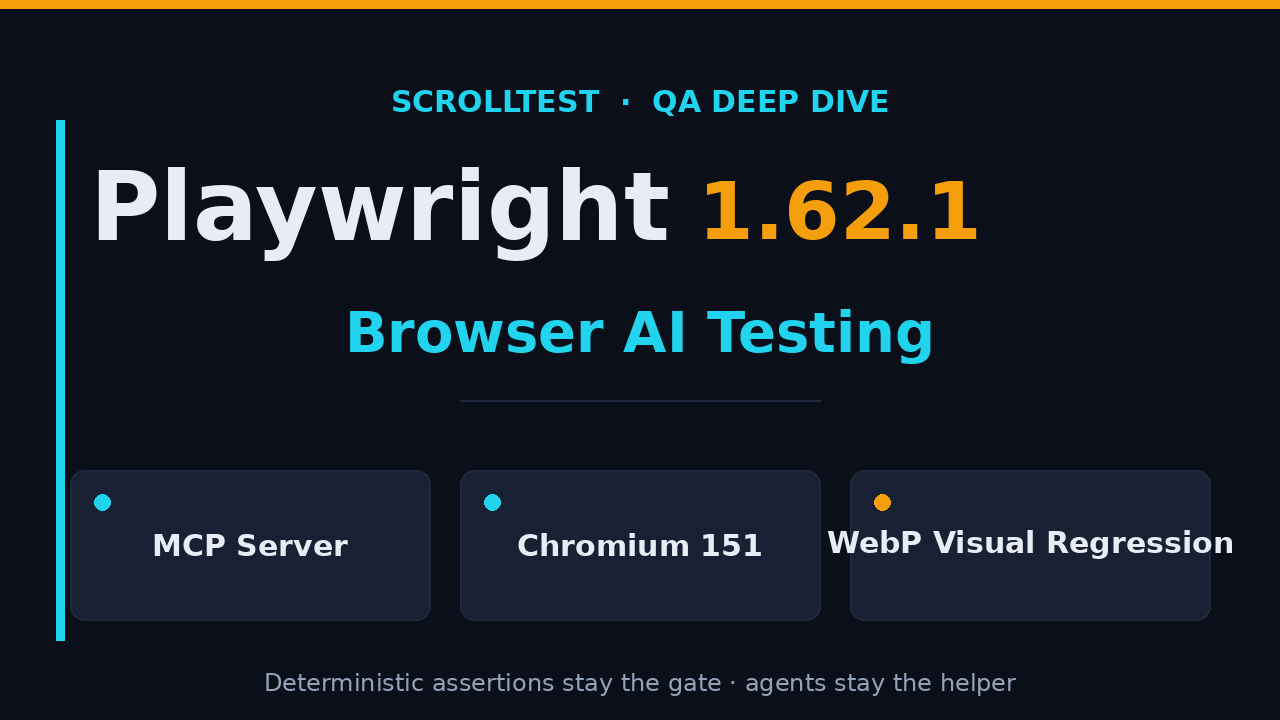
Table of Contents
- What Shipped in Playwright 1.62.1
- The Engine Bump: Chromium 151, Firefox 153, WebKit 26.5
- The Bundled MCP Server: Why AI Agents Care
- WebP Screenshots Change Visual Regression
- Component Testing’s Stories and Galleries Model
- AbortSignal, Isolated Retries, and Custom Filtering
- The Numbers Behind the Release
- A Practical Upgrade Path for QA Teams
- Key Takeaways
- FAQ
Playwright browser AI testing stopped being a side project the week Microsoft bundled an MCP server into the framework. Version 1.62.1, released on July 30, 2026, ships npx playwright mcp, a WebP-based visual regression path, and a Chromium 151 engine bump in a single release. If you run browser tests for a QA team, this is the release that turns your spec files into something an AI agent can actually drive.
Contents
What Shipped in Playwright 1.62.1
Playwright 1.62.0 landed on July 24, 2026, and 1.62.1 followed six days later as a small patch release. The 1.62.1 tag fixes five regressions that shipped in 1.62.0, mostly around TypeScript config resolution and accessibility snapshots. I treat the two as one release train for the purposes of this article, because most teams will land on 1.62.1 anyway.
Here is what the release actually contains, according to the official 1.62.0 release notes:
- A new component testing model built around stories and galleries
- An
AbortSignaloption for cancelling actions, navigations, waits, and assertions - WebP screenshot support in
toHaveScreenshot()andpage.screenshot() - A
Reporter.preprocess()hook for filtering tests before the run starts - An
isolatedretry strategy that runs retries at the end of a suite - WebAuthn credential persistence in storage state
- A bundled MCP server and CLI, runnable via
npx playwright mcpandnpx playwright cli
That last bullet is the one I keep coming back to. Everything else in this release is a steady, useful improvement. The MCP server is a signal about where browser testing is heading, and I will spend the most time on it below.
The Engine Bump: Chromium 151, Firefox 153, WebKit 26.5
Every Playwright release ships a matching set of browser engines, and 1.62 is a noticeable jump. The bundled browsers are now Chromium 151.0.7922.34, Firefox 153.0, and WebKit 26.5, per the release notes. The release was also tested against the stable Google Chrome 151 and Microsoft Edge 151 channels.
Why does an engine bump matter to a tester? Because a large share of flaky browser tests trace back to browser bugs, not test bugs. When you run CI against an old Chromium build while your users are on Chrome 151, you are testing a browser nobody ships. Keeping the engine current closes that gap.
There are two practical things I do on every Playwright upgrade, and both matter here:
- Diff my
playwright.config.tschannel setting against the bundled version. If I pinchannel: 'chrome', I want the stable Chrome the release tested against, which is 151 here. - Re-run my visual regression baselines. An engine bump shifts font rendering and anti-aliasing at the margins, which means my golden screenshots will drift even when the app did not change.
One breaking change is worth flagging: Debian 11 is no longer supported. If your CI runners sit on Debian 11 (bullseye), this is the release that forces an upgrade to Debian 12 or a move to a container image that already runs it. I have seen more than one team hit this only after the pipeline went red.
The engine bump matters twice as much once AI agents enter the picture. An agent that drives the browser through MCP is only as accurate as the engine it controls. If your bundled Chromium lags the browser your users actually run, an agent can “pass” a scenario locally that fails in production. Keeping the engine current keeps both your assertions and your AI tooling honest about what a real user would see.
Playwright Browser AI Testing: The Bundled MCP Server
This is the headline feature for Playwright browser AI testing. Playwright now bundles the Playwright MCP server and a command-line runner directly in the package. You start them with:
npx playwright mcp
npx playwright cli
MCP, the Model Context Protocol, is how AI tools like Claude, Cursor, and other coding agents talk to external tools. Before this release, wiring Playwright into an AI agent meant running a separate MCP package and keeping it in sync with your Playwright version. Now the MCP server ships with the framework itself, so the version drift problem disappears.
What this means for a QA team is concrete. An AI agent can now open a browser, navigate, click, read the accessibility tree, and screenshot a failure using the same Playwright installation your tests already use. The agent is not calling a parallel stack. It is calling your stack.
Here is where I think it gets interesting. The accessibility snapshot that Playwright exposes is exactly what the MCP server hands to an AI agent, and it is a cleaner input than raw DOM for reasoning about what is on screen. That means AI-assisted triage gets a better starting point: element roles, names, and state, not a wall of HTML.
I covered how teams are using AI for failure triage on Playwright in a separate walkthrough. The MCP server closes the loop on that workflow, because now the triage agent and the test runner speak the same protocol. If you are building AI agents that touch the browser, you should also understand how agent memory and state work, which I wrote about in the LangGraph QA guide.
There is a caution here. An AI agent driving a browser through MCP is not a substitute for deterministic assertions. Agents are probabilistic. Your expect() calls are not. The right split, in my view, is agents for exploration, triage, and drafting tests, and Playwright assertions for the pass/fail gate. That is the same split BrowsingBee uses for its AI browser testing features, and it keeps the CI gate deterministic even when the agent is doing heavy lifting.
How the pieces fit together
Here is the workflow I have settled on. A test fails in CI with a screenshot and a trace attached. The AI agent, connected through the MCP server, opens the failing page, reads the accessibility snapshot, and drafts a theory about what broke: a selector drift, a timing issue, a real product regression. A human (or a deterministic check) confirms the theory, and the fix lands as a proper assertion change, not as an agent editing the spec on its own.
The reason this works is that the agent and the runner now share one browser install and one read model. There is no translation layer where the agent’s understanding of the page drifts from what Playwright actually sees. The accessibility snapshot the agent reads is the same one your expect() assertions are built on.
That said, the agent is only as good as the snapshot it gets. If a page renders its meaningful content inside an aria-hidden SVG or an image without a name, the agent misses it, which is exactly the class of bug the 1.62.1 patch fixed. Browser AI testing is still limited by how well the page exposes its semantics.
What the MCP server gives you today
- Browser navigation, clicks, and input driven by an AI client
- Accessibility snapshots as the primary read model for the agent
- Screenshots for visual evidence when an agent needs to “see” a page
- Version parity with your Playwright install, since it ships in the same package
WebP Screenshots Change Visual Regression
Playwright 1.62 adds WebP as a first-class screenshot format. toHaveScreenshot() and locator.toHaveScreenshot() can now store golden snapshots as WebP by giving the file a .webp name. Standalone screenshots get the same treatment.
// Golden snapshot stored as lossless WebP.
await expect(page).toHaveScreenshot('homepage.webp');

// Trade quality for size on a standalone screenshot.
await page.screenshot({ path: 'homepage.webp', quality: 50 });
For visual regression, this is a storage and speed win, not a correctness feature. WebP lossless files are smaller than PNG for most screenshot content, so your snapshot repo shrinks and image comparisons move faster. The default quality: 100 is lossless; lower values use lossy compression when you want a smaller artifact for debugging rather than a strict baseline.
One thing I would not do is mix formats inside a single visual regression suite. If half your baselines are PNG and half are WebP, you create confusion about which encoder produced which pixel. Pick one format per project and stick with it. If you adopt WebP, regenerate all baselines in one pass rather than converting them piecemeal.
Visual regression also pairs naturally with the engine bump I mentioned earlier. When you regenerate WebP baselines after upgrading to Chromium 151, you bake in the new rendering. Do both at the same time and you only pay the baseline migration cost once.
On the size question, the difference is real but not dramatic. Lossless WebP typically lands somewhere between 25 and 35 percent smaller than the equivalent PNG for the kind of flat UI screenshots a test suite produces. Across a thousand baselines, that is meaningful repo space and faster diffs. The bigger win is fewer merge conflicts on binary snapshots, because smaller files churn less in git when developers re-run suites locally.
Component Testing’s Stories and Galleries Model
Playwright’s component testing now uses a stories and galleries model. A story wraps one component in one specific scenario with hard-coded props, mock data, and providers. A gallery page renders those stories on demand. The new fixtures.mount() fixture navigates to the gallery, mounts a story by id, and returns a Locator scoped to the story’s root element.
test('click should expand', async ({ mount }) => {
  const component = await mount('components/Expandable/Stateful');
  await component.getByRole('button').click();
  await expect(component.getByTestId('expanded')).toHaveValue('true');
});
You can pass a story type as a template argument to type-check props, and use update(props) or unmount() on the returned locator to re-render or tear down within a test.
The practical value here is isolation. Instead of rendering an entire app to test one component, you mount exactly the scenario you need. That means faster component tests and fewer moving parts to debug when one fails. If you are coming from Storybook, the mental model maps over cleanly: stories are your scenarios, and the gallery is the render host.
I will be honest that this is a shift if you built component tests on the older Playwright model. The upgrade is not a drop-in for every existing suite, so budget a migration window rather than assuming your current component specs keep passing unchanged.
AbortSignal, Isolated Retries, and Custom Filtering
Three smaller features in 1.62 deserve attention because they change how you structure a suite, not just what a single test can do.
AbortSignal for cancelling work
Most actions, navigations, waits, and web-first assertions now accept a signal option that takes an AbortSignal. This lets you cancel a long-running operation on a deadline instead of waiting out the default timeout.
const controller = new AbortController();
setTimeout(() => controller.abort(), 1000);

await page.getByRole('button', { name: 'Submit' }).click({ signal: controller.signal });
await expect(page.getByText('Done')).toBeVisible({ signal: controller.signal });
Providing a signal does not disable the default timeout. Pass timeout: 0 if you want the signal to be the only thing controlling the wait. For suites that hang on flaky third-party calls, this is a clean way to cap wasted CI time.
Isolated retries
The new retryStrategy config controls when failed tests retry. The default 'immediate' retries as soon as a worker frees up. The 'isolated' mode runs all retries at the end, one at a time in a single worker, to reduce interference with the rest of the suite.
export default defineConfig({
  retries: 2,
  retryStrategy: 'isolated',
});
I like 'isolated' for flaky suites because it stops a burst of retries from stampeding shared state mid-run. If a retry is going to pass, it has a better chance when it runs in a quiet worker after the main suite settles.
Reporter.preprocess() for custom filtering
The new preprocess() reporter hook runs after config resolution and before onBegin(). A reporter can mark individual tests as skipped, excluded, fixed, or failing through a TestRun object.
class MyReporter {
  async preprocess({ config, suite, testRun }) {
    for (const test of suite.allTests()) {
      if (shouldSkip(test))
        testRun.skip(test);
    }
  }
}
This is the feature that used to require a pile of test.skip() calls scattered through your specs or a custom runner wrapper. Now you can centralize skip logic in one place based on whatever signal you want: a label, a git branch, a feature flag, a flaky-test registry. For a large suite, that single hook is worth the upgrade on its own.
The Numbers Behind the Release
Playwright’s adoption is not a niche story anymore. The microsoft/playwright repository sits at roughly 94,500 GitHub stars as of mid-August 2026. The playwright npm package pulls about 300.9 million downloads a month, and @playwright/test adds another 204 million, according to the npm downloads API.
The year-over-year trend is the number that tells you where the market is going. @playwright/test grew from about 395 million downloads over the twelve months ending July 2025 to about 1.25 billion over the twelve months ending July 2026, a 3.16x increase. Over the same window, selenium-webdriver holds at roughly 8 million downloads a month. I broke down the full comparison in the Playwright vs Selenium 2026 post, and the gap has not narrowed.
What this means for a QA team is simple. If you are hiring for browser automation or evaluating which framework to standardize on, the momentum is behind Playwright, and the 1.62 release only extends it. The engine bump keeps tests on current browsers, and the MCP server positions Playwright as the bridge between your test suite and the AI tooling your team is starting to adopt.
A Practical Playwright Browser AI Testing Upgrade Path
I have upgraded Playwright enough times to have a checklist. Here is the order I follow, and it works for 1.62.
- Read the release notes for both 1.62.0 and 1.62.1, and check the browser versions.
- Check your CI image. If it is Debian 11, move to Debian 12 or a current Playwright Docker image first.
- Bump
@playwright/testandplaywrightto 1.62.1, then runnpx playwright installto pull the new engines. - Run your visual regression suite and regenerate baselines. Do it once, in a single pass, ideally switching to WebP at the same time.
- If you use component testing, review your existing specs against the new stories and galleries model before assuming they pass.
- Turn on
retryStrategy: 'isolated'if your suite is flaky, and centralize any scattered skip logic into apreprocess()reporter. - Try
npx playwright mcpin a sandbox and see what your AI coding tool can do with it before you wire it into anything production-facing.
For QA engineers in India, the incentives line up directly with this release. Hiring managers in Bengaluru, Hyderabad, and Pune are screening for automation engineers who can talk about AI-assisted testing, and an MCP server bundled into the framework is exactly the kind of detail that separates a memorized resume from someone who actually runs these tools. Product companies are increasingly asking for Playwright plus AI tooling in the same job description, and the salary band for that combination sits comfortably in the ₹25 to 40 LPA range for mid-to-senior SDET roles, based on the listings I watch.
I see the same shift inside service companies. Teams that spent a decade standardizing on Selenium with Java are now running parallel Playwright pilots, and the engineers who volunteer for those pilots are the ones getting the AI testing work that follows. In TCS, Infosys, and the product startups alike, the differentiator is no longer whether you can write a locator. It is whether you can reason about what an AI agent got right and wrong.
The fastest way to get comfortable is to run it, not read about it. Upgrade one side project, point an AI agent at it through the MCP server, and watch what it can and cannot do. The gap between what an agent handles and what you still need to assert manually is the skill that will matter in the next hiring cycle.
Key Takeaways
- Playwright 1.62.1 bundles an MCP server (
npx playwright mcp), which is the biggest step yet toward Playwright browser AI testing. - The engine bump moves bundled browsers to Chromium 151, Firefox 153, and WebKit 26.5, and Debian 11 support is gone.
- WebP screenshots make visual regression baselines smaller and faster, and pair well with a baseline regeneration after the engine bump.
AbortSignal,retryStrategy: 'isolated', andReporter.preprocess()give you cleaner control over timeouts, retries, and test filtering.- Adoption keeps compounding: roughly 94,500 GitHub stars and 300.9 million npm downloads a month, with
@playwright/testup 3.16x year over year.
FAQ
Is Playwright 1.62.1 stable enough for production?
Yes. 1.62.1 is the patch that fixed the regressions shipped in 1.62.0, mostly around TypeScript config resolution and accessibility snapshots. Treat 1.62.0 and 1.62.1 as one train and land on 1.62.1.
What exactly is the Playwright MCP server?
It is an MCP (Model Context Protocol) server that ships inside the Playwright package. AI tools like Claude and Cursor connect to it, and it lets them drive a browser, read the accessibility tree, and capture screenshots through the same Playwright install your tests use.
Do I need to rewrite my component tests for 1.62?
Not necessarily, but the new stories and galleries model is a shift from the older approach. Review your existing component specs before assuming they pass unchanged, and budget a migration window if you rely on component testing heavily.
Will the Chromium 151 engine bump break my visual regression baselines?
It can, because an engine bump shifts font rendering and anti-aliasing at the margins. Regenerate your baselines in one pass after upgrading, and consider moving to WebP at the same time so you only pay the migration cost once.
Can AI agents replace my Playwright assertions?
No. Agents are probabilistic and useful for exploration, triage, and drafting tests. Your expect() assertions are the deterministic gate and should stay that way. Use both, but do not let an agent own the pass/fail decision.