MCP for QA Engineers: Replace Brittle Scripts
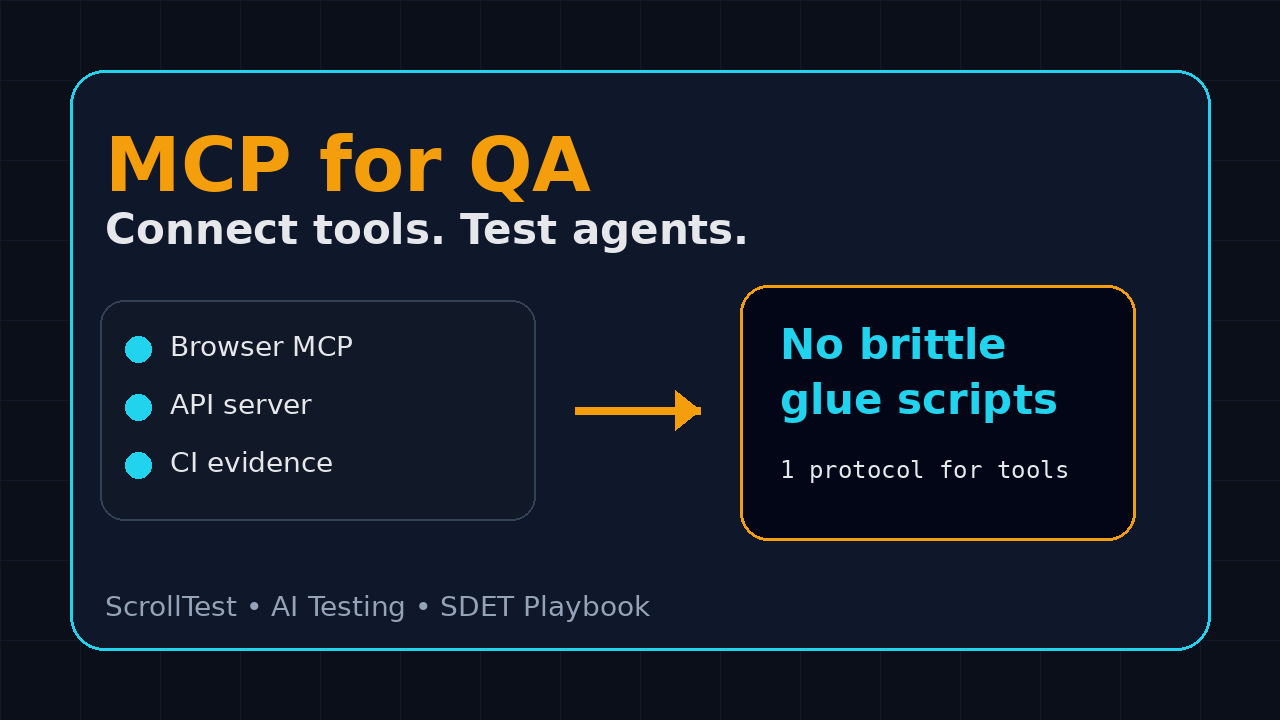
MCP for QA engineers is becoming a practical answer to a boring but expensive problem: every AI testing assistant needs safe access to browsers, APIs, logs, files, tickets, and test evidence. I do not want another folder of one-off Python scripts that only the original author understands. I want a predictable contract that QA teams can test like any other integration.
Table of Contents
- What MCP Means for Testers
- Why QA Glue Scripts Break
- Reference Architecture
- Build a Tiny Test Evidence MCP Server
- How to Test MCP Servers
- CI Roadmap for QA Teams
- India Context for SDETs
- Common Mistakes
- Key Takeaways
- FAQ
Contents
What MCP for QA Engineers Means
It is not another test framework
The Model Context Protocol, usually called MCP, defines a standard way for applications and AI assistants to connect with external tools and data sources. The official MCP repository says it contains the protocol specification, schema, and documentation, with the schema defined first in TypeScript and also published as JSON Schema for wider compatibility. That matters to QA because a protocol gives us a thing to verify, not just a prompt to hope for. Source: Model Context Protocol specification repository.
Think of MCP as the USB-C idea applied to AI tool access. The testing assistant remains the client. Your browser controller, database reader, test report service, Jira search, log collector, and file store become servers. The assistant asks for a capability through the protocol instead of scraping random CLI output or guessing a hidden API shape.
Why QA should care in 2026
The signal is no longer small. On the day I checked, the official Python SDK repository showed 23,764 GitHub stars, the official TypeScript SDK showed 12,980 stars, and Microsoft’s Playwright MCP server showed 35,581 stars. The npm downloads API reported 176,570,177 downloads for @modelcontextprotocol/sdk in the 2026-06-25 to 2026-07-24 window, and 26,212,848 downloads for @playwright/mcp in the same window. Sources: GitHub Python SDK API, GitHub TypeScript SDK API, GitHub Playwright MCP API, and npm downloads API.
Numbers alone do not prove quality. They do prove adoption pressure. If developers start wiring agents to source code, browser sessions, and production-like logs through MCP, QA engineers need to know how to test those connections before a bad tool call creates a false green build.
My working definition
For a QA team, MCP is a testable boundary around AI tool access. A good MCP server tells the assistant what it can do, validates every input, returns structured output, and leaves enough evidence for a human to debug the action later. A bad MCP server becomes a remote control with weak permissions and vague logs.
Why MCP for QA Engineers Beats Brittle Scripts
Most automation teams already have glue scripts. One script fetches logs. One script exports Playwright traces. One script hits a test management API. One script downloads screenshots from CI. The first month feels productive. By month six, the team has 18 scripts, 5 environment variable formats, 3 auth patterns, and zero confidence that a new AI assistant will call them safely.
This is where MCP for QA engineers earns attention. The point is not that MCP magically tests your app. The point is that it reduces integration chaos. A protocol can describe tools, resources, prompts, parameters, and responses in a form that clients can inspect. Testers can assert those contracts. Security reviewers can reason about allowed actions. CI can run compatibility smoke checks after SDK upgrades.
Four failure modes I see repeatedly
- A script accepts free-form text where a typed schema should exist.
- A script returns a pretty table instead of JSON that another tool can validate.
- A local path, token name, or browser profile is hard-coded for one engineer’s laptop.
- A command works in a demo but fails inside CI because the timeout, cwd, or network policy changed.
MCP does not remove engineering discipline. It forces the discipline into a place QA can inspect. That is a better deal than debugging a failed agent run from a 2,000-line terminal transcript.
Related ScrollTest playbooks
I have already written about adjacent risks in MCP Server Testing: Stop Agent Breakage and MCP Server Regression Testing for QA Teams. Read those after this article if you want a checklist-heavy version of the same problem.
A Practical MCP Architecture for QA Teams
Keep the layers boring
The safest design is boring. Put the AI assistant at the edge. Put MCP clients between the assistant and the server. Put the server between the client and real systems. Then isolate permissions at the server boundary. I prefer this shape because it gives QA four separate things to test: discovery, input validation, execution, and evidence.
- Client discovers server capabilities and tool schemas.
- Client calls one tool with typed arguments.
- Server validates auth, parameters, timeout, and allowed environment.
- Server performs the action and returns structured evidence.
- Audit logs capture who called what, when, with which input, and with which result.
Server types worth building first
Do not start with 30 tools. Start with 3 servers that remove daily QA friction. A browser evidence server can expose screenshots, traces, console logs, and network failures. An API contract server can fetch OpenAPI schemas, recent test failures, and environment health. A CI evidence server can summarize a failing pipeline and link to artifacts.
Microsoft’s Playwright MCP project is useful to study because it connects browser automation to MCP. I would still wrap production usage with team-specific permissions. Browser control is powerful. Powerful means test it harder.
Permissions are a QA concern
Permission design is not only a security topic. It is a testability topic. If an MCP server can read any file, call any endpoint, or mutate any ticket, a test cannot define a safe blast radius. For QA use cases, I split tools into read-only, write-with-approval, and blocked-in-CI groups.
- Read-only: fetch test report, get trace metadata, read API schema, query defect by ID.
- Write-with-approval: create bug, rerun flaky job, update test status, attach screenshot.
- Blocked-in-CI: delete data, change permissions, run arbitrary shell commands, hit production-only endpoints.
Build a Tiny Test Evidence MCP Server
The use case
Let us build a small example: an MCP tool called getLatestTestEvidence. It returns the latest Playwright report URL, failed test names, screenshot paths, and trace links. This is intentionally narrow. Narrow tools are easier to review, easier to test, and harder for an assistant to misuse.
TypeScript server example
import { McpServer } from '@modelcontextprotocol/sdk/server/mcp.js';
import { StdioServerTransport } from '@modelcontextprotocol/sdk/server/stdio.js';
import { z } from 'zod';

const server = new McpServer({
  name: 'qa-evidence-server',
  version: '1.0.0'
});

server.tool(
  'getLatestTestEvidence',
  'Return latest Playwright failure evidence for a CI build',
  { buildId: z.string().regex(/^build-[0-9]+$/) },
  async ({ buildId }) => {
    // Replace this with your CI artifact API call.
    const evidence = {
      buildId,
      reportUrl: `https://ci.example.test/reports/${buildId}`,
      failedTests: ['checkout.spec.ts > applies coupon'],
      traces: [`https://ci.example.test/traces/${buildId}/checkout.zip`],
      screenshots: [`https://ci.example.test/screenshots/${buildId}/coupon.png`]
    };

    return {
      content: [
        { type: 'text', text: JSON.stringify(evidence, null, 2) }
      ]
    };
  }
);

const transport = new StdioServerTransport();
await server.connect(transport);
The important part is not the fake CI URL. The important part is the schema. The buildId pattern blocks sloppy inputs before any downstream API is called. If the assistant sends prod, ../../../secrets, or a natural-language paragraph, the server should reject it before execution.
Contract tests to add immediately
A QA engineer should add tests at the MCP boundary, not only at the CI API boundary. At minimum, test discovery, valid input, invalid input, timeout behavior, and evidence shape.
import { describe, expect, test } from '@playwright/test';

describe('qa-evidence MCP contract', () => {
  test('rejects invalid build IDs before execution', async () => {
    const response = await callMcpTool('getLatestTestEvidence', {
      buildId: '../../../etc/passwd'
    });

    expect(response.error?.message).toContain('Invalid input');
  });

  test('returns trace and screenshot links for a valid build', async () => {
    const response = await callMcpTool('getLatestTestEvidence', {
      buildId: 'build-1042'
    });

    const data = JSON.parse(response.content[0].text);
    expect(data.reportUrl).toContain('/reports/build-1042');
    expect(data.failedTests.length).toBeGreaterThan(0);
    expect(data.traces[0]).toMatch(/\.zip$/);
    expect(data.screenshots[0]).toMatch(/\.png$/);
  });
});
How to Test MCP Servers Like a QA Engineer
Use a small pyramid, not a giant demo
I use a simple test pyramid for MCP servers. Unit tests validate schema and permission rules. Contract tests validate tool discovery and response shape. Integration tests call a fake downstream service. End-to-end tests run one assistant-style workflow with real artifacts but fake credentials.
- Schema tests: required fields, regex rules, enum values, default values.
- Permission tests: read-only user, CI user, admin user, expired token.
- Failure tests: downstream 500, slow response, empty artifact, malformed JSON.
- Evidence tests: logs include request ID, build ID, tool name, duration, and sanitized error.
Negative tests are non-negotiable
The happy path is easy. The risk sits in negative paths. MCP servers often bridge an assistant to systems with real authority. That means prompt injection, path traversal, oversized payloads, rate limits, and unexpected tool chaining deserve tests. If this sounds like API testing, good. MCP server testing is API testing with an AI client in front.
For LLM quality checks around agent output, connect this with DeepEval for QA Engineers. MCP tests verify the tool boundary. Evals verify whether the assistant used that tool correctly and explained the result without hallucinating.
Observability checks
Every tool call should create a short audit event. I want five fields in every event: request ID, tool name, caller identity, sanitized input summary, and result status. Add duration too. If an assistant creates a wrong bug or reads the wrong report, the QA team should reconstruct the path in 2 minutes, not 2 hours.
MCP for QA Engineers: CI Roadmap
First 30 days
In the first 30 days, do not connect MCP to production data. Pick one read-only server and one safe workflow. My preferred starter is test evidence retrieval because it has visible value and low mutation risk. The assistant can summarize a failing build, link the trace, and suggest the next debugging step.
- Create one read-only MCP server for test evidence.
- Add schema tests and invalid-input tests.
- Run the server locally with sample CI artifacts.
- Add a CI job that runs MCP contract tests on every pull request.
- Log every tool call with request ID and duration.
- Document what the assistant is allowed to do and what it must never do.
A release gate that is actually useful
A useful CI gate checks that the server starts, exposes expected tools, rejects bad inputs, and returns parseable evidence for a known fixture. It should not ask an LLM to judge whether the server feels correct. Save LLM evaluation for workflow-level behavior. Keep protocol compatibility deterministic.
name: mcp-contract-check
on: [pull_request]
jobs:
  mcp:
    runs-on: ubuntu-latest
    steps:
      - uses: actions/checkout@v4
      - uses: actions/setup-node@v4
        with:
          node-version: 22
      - run: npm ci
      - run: npm run test:mcp-contract
      - run: npm run test:mcp-negative
Upgrade checks after SDK changes
The official Python SDK released v2.0.0 on 2026-07-28 and says v2 supports the 2026-07-28 revision of the protocol while v1.x moves to maintenance mode for security fixes. Source: MCP Python SDK v2.0.0 release notes. That kind of change is exactly why QA teams need a repeatable upgrade suite.
When an SDK moves major versions, I run the contract suite twice: once against the old server build and once against the new build. I compare tool names, schemas, error messages, auth behavior, and response shape. If any response changes, the assistant prompt and downstream evals may need updates too.
I also pin the server package version in CI for the first rollout. Floating versions are fine for experiments, not for a tool that can read reports, call browser sessions, and create tickets. Upgrade on a branch, run the MCP contract pack, inspect the changelog, and merge only when the evidence says the boundary is stable.
A second useful check is a golden transcript. Save one known client request and one known response for each high-value tool. After an SDK upgrade, replay those transcripts against fixtures. If the JSON shape, error wording, or content type changes, treat it as a compatibility event, not as a random snapshot update.
India Context: SDET Careers and Hiring
The signal hiring managers will notice
In India, most QA resumes still cluster around Selenium, Java, Playwright, API testing, and CI/CD. Those skills still matter. MCP adds a newer signal: can you test AI tool integrations with the same discipline you bring to APIs and pipelines? For SDETs targeting product companies, that signal can separate a ₹12 LPA automation profile from a ₹25-40 LPA AI testing profile, especially when the candidate can show a working repo and a CI gate.
A practical portfolio project
Build a portfolio repo called qa-evidence-mcp. It should include one MCP server, Playwright report fixtures, contract tests, GitHub Actions, and a README with screenshots of failing and passing runs. Add one page explaining what risks you tested: invalid input, missing artifact, slow downstream service, and prompt injection through a test name.
If you want a 7-day structure for that portfolio, pair this with AI Agent Testing Sprint: 7-Day QA Plan. The difference is simple: that sprint focuses on agent behavior, while this article focuses on the tool boundary that feeds the agent.
What teams should train
For TCS, Infosys, Wipro, and services teams, MCP matters because enterprise clients will ask for controlled AI access to internal tools. For product companies, MCP matters because engineering teams want AI assistants inside daily workflows without giving them unsafe shortcuts. In both cases, QA should own the verification story.
Common MCP Mistakes QA Teams Should Catch
Mistake 1: too many tools too early
A server with 40 tools looks impressive in a demo and painful in maintenance. Start with 3 to 5 tools. Each tool needs a schema, permission rule, fixture, negative test, and logging assertion. If your team cannot test the tool, the assistant should not use it.
Mistake 2: natural-language input everywhere
Natural language belongs in the assistant layer. Tool input should be typed. A tool named runApiCheck should receive environment, collectionId, and timeoutMs, not a paragraph that says “check staging quickly.” Typed input makes failures reproducible. Reproducibility is the QA advantage.
Mistake 3: summaries without source links
If an MCP tool returns “5 tests failed” without links to the report, trace, screenshot, or log, it creates another trust problem. The assistant summary is not evidence. The evidence is the artifact. Make artifact URLs part of the response contract.
Mistake 4: no rate limit or timeout
Agents retry. Humans retry with judgment. Agents retry because the loop says retry. Add timeouts, rate limits, and max payload sizes. Then test them. A single stuck MCP call should not hang a CI job for 45 minutes or spam a defect tracker with duplicate bugs.
MCP for QA Engineers: Key Takeaways
MCP for QA engineers is not hype when you treat it as a protocol boundary and test it like one. The value appears when a team replaces private glue scripts with typed, observable, permission-aware tool servers.
- MCP gives QA a testable contract for AI tool access.
- Start with read-only evidence retrieval before write actions.
- Use TypeScript schemas, negative tests, and CI contract checks.
- Track adoption signals, but trust your own test evidence.
- For Indian SDETs, an MCP portfolio project is a strong AI testing signal.
My rule is simple: if an AI assistant can call a tool, QA owns the safety checks around that tool. That is how SDETs move from “we test after development” to “we design the control layer for AI-assisted engineering.”
FAQ
Is MCP replacing Playwright or Selenium?
No. MCP is not a browser automation framework. Playwright and Selenium automate browsers. MCP connects AI clients to tools and data sources. A Playwright MCP server may expose browser capabilities through the protocol, but the browser automation engine is still Playwright.
Should QA engineers learn MCP now?
Yes, if you already know API testing, CI, and at least one automation framework. Do not skip fundamentals. MCP becomes valuable when you can test schemas, permissions, errors, logs, and real workflow behavior.
What is the safest first MCP project for a QA team?
Build a read-only test evidence server. Let it return report URLs, trace files, screenshots, and failed test names for a known CI build. Avoid write actions until the team has contract tests, audit logs, and permission checks.
How is MCP testing different from API testing?
The mechanics overlap: schemas, inputs, outputs, auth, timeouts, and errors. The difference is the caller. MCP tools are often called by an AI assistant, so QA must also test misuse patterns, prompt-injection paths, and whether the assistant explains tool results accurately.
Which language should I use first?
For most QA teams, TypeScript is a good first choice because Playwright, CI examples, and web tooling fit naturally. Python is also strong, especially for data-heavy QA workflows. Pick the language your team can maintain for 12 months.