LangGraph 1.2.10 Testing Playbook for QA Teams
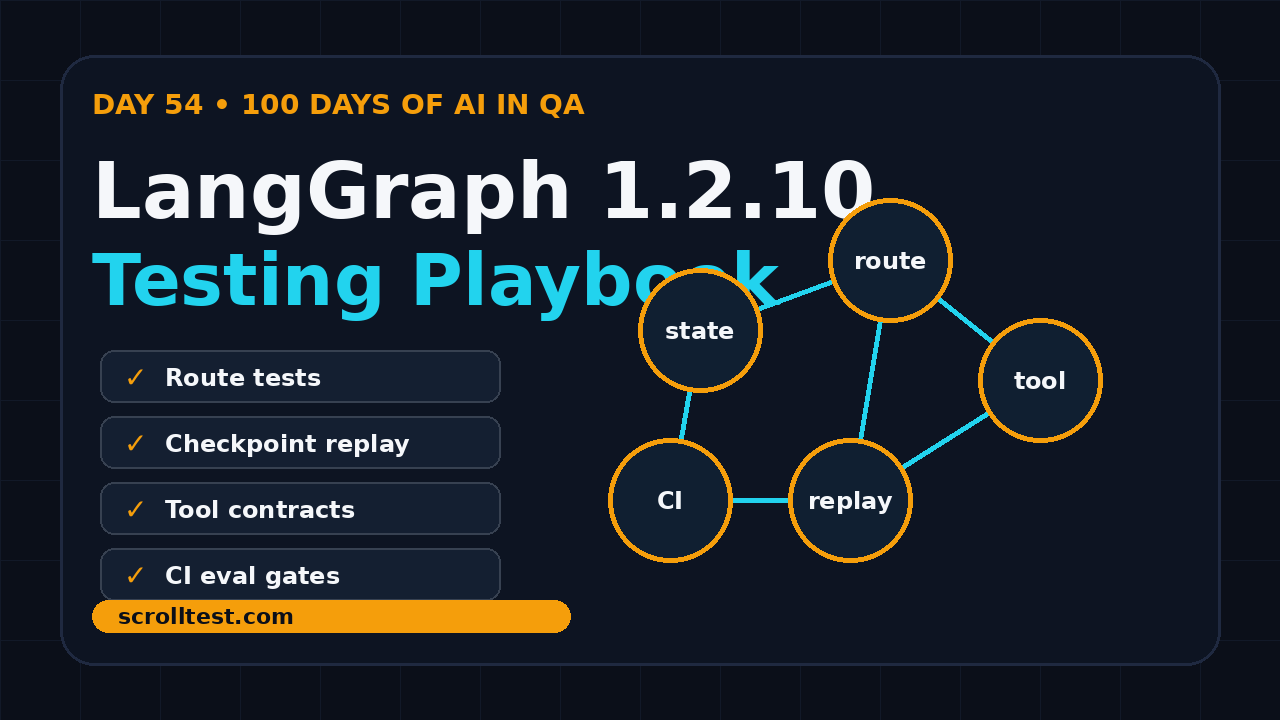
Day 54 of 100 Days of AI in QA and SDET. This LangGraph 1.2.10 testing playbook is for QA teams that are moving from simple prompt tests to stateful AI agents. I focus on the parts that actually break in production: state transitions, checkpoint replay, tool calls, retries, memory, and CI gates.
LangGraph is not another chat wrapper. The official package describes it as a way to build stateful, multi-actor applications with LLMs, and the GitHub project tagline is blunt: Build resilient agents. That word resilient is exactly where QA needs to show up.
Table of Contents
- Why LangGraph needs a QA playbook
- What changed in LangGraph 1.2.10
- LangGraph 1.2.10 testing playbook foundation
- State graph test cases that catch real bugs
- Checkpoint, replay, and memory tests
- Tool-call contract tests
- CI gates for LangGraph agents
- India SDET career angle
- Key takeaways
- FAQ
Contents
Why LangGraph needs a QA playbook
I see many teams make the same mistake with AI agents. They test one happy prompt, see a useful answer, and call the agent ready. That is not testing. That is a demo.
A LangGraph application has nodes, edges, state, tools, and often a checkpoint saver. A bug can hide in any of those layers. The LLM can choose the wrong tool. A node can mutate state in a way the next node does not expect. A retry can replay the wrong input. A checkpoint can restore stale data. A conditional edge can route a user into a dead branch.
Traditional API tests still matter, but they are not enough. With agents, the quality question changes from “did this endpoint return 200” to “did this graph reach the right state for the right reason under messy inputs?” That needs a sharper test model.
Agents fail like workflows, not pages
When a UI test fails, I can usually point to one selector, one assertion, or one network call. Agent failures are more distributed. The visible answer may look fine while the graph takes an unsafe path. The agent might call a refund tool before verifying identity. It might retrieve the right policy but ignore the latest user intent. It might pass locally and fail in CI because a checkpoint changed the next step.
That is why I test LangGraph like a workflow engine with probabilistic nodes, not like a static prompt. I want evidence for the path, the state, and the final answer.
The QA target is observability plus control
Good agent tests need two things:
- Observability: capture the graph path, state diff, tool calls, model outputs, and errors.
- Control: freeze model responses, mock tools, replay checkpoints, and compare expected state.
- Risk grouping: split failures into product bug, prompt drift, retrieval issue, tool issue, or dataset gap.
I use the same mental model in AI test failure classification. If your team cannot classify a failure, it cannot fix the right layer.
What changed in LangGraph 1.2.10
The current PyPI metadata shows langgraph version 1.2.10. The GitHub release page lists langgraph==1.2.10 published on 28 July 2026. I treat this as a good trigger to refresh test suites because agent frameworks change faster than most QA calendars.
Two companion checkpoint packages are also worth tracking. PyPI shows langgraph-checkpoint-sqlite 3.1.1 and langgraph-checkpoint-postgres 3.1.1. That matters because persistence is not a nice extra in agent testing. It is where replay, recovery, and long-running workflow bugs appear.
Do not over-read a version number
I do not claim 1.2.10 magically changes your whole testing strategy. A patch release may be small. The useful habit is this: every framework update should trigger a focused risk review. Look at graph execution, checkpoint behavior, package compatibility, and the minimum suite you need before merging.
For a similar release-driven habit, read the Playwright 1.62 upgrade checklist. The same idea applies here: map release notes to risk tickets, not vague “upgrade done” comments.
What I validate after a LangGraph bump
- Can the graph compile with the current nodes, edges, and state schema?
- Do core scenario paths still visit the expected nodes?
- Do checkpoint savers serialize and restore the same state shape?
- Do mocked tool calls still match the tool contract?
- Does the CI eval gate catch a deliberately bad prompt or route?
This five-point check is small enough to run in a pull request and strong enough to catch the most expensive mistakes.
LangGraph 1.2.10 testing playbook foundation
The foundation of a LangGraph 1.2.10 testing playbook is a test matrix that separates deterministic graph behavior from model quality. If you mix both in one test, debugging becomes painful. A failed assertion could mean a bad prompt, a broken node, a slow external tool, a dataset problem, or a model temperature issue.
I split the suite into four layers:
- Graph unit tests: node logic, state updates, and route decisions with model calls mocked.
- Tool contract tests: schemas, permissions, error cases, timeouts, and idempotency.
- Replay tests: checkpoint restore, resume, retry, and interrupted workflow behavior.
- Eval tests: model output quality, retrieval quality, refusal behavior, and business rules.
Start with state, not prompts
Prompts are visible, so teams test them first. State is less visible, so teams ignore it until production. That is backwards for LangGraph. The graph moves by state. If state is wrong, the agent will make wrong decisions even with a decent prompt.
Define the state fields that matter to the business. For a support agent, that may be user_id, verified_identity, selected_policy, issue_type, escalation_required, and tool_results. For a QA assistant, it may be requirement_id, generated_tests, risk_level, evidence_links, and final_recommendation.
Make the graph path assertable
Every critical scenario should have an expected path. If the user asks for refund status without identity verification, the graph should not call a payment tool. It should visit the verify_identity node first. That is a testable behavior.
# pytest-style sketch for route assertions

def test_unverified_refund_request_routes_to_identity_check(graph, fake_llm):
    fake_llm.respond_with("User wants refund status but is not verified")

    result = graph.invoke({
        "message": "Where is my refund?",
        "user_id": "u_123",
        "verified_identity": False,
        "visited_nodes": []
    })

    assert "verify_identity" in result["visited_nodes"]
    assert "payment_status_tool" not in result["visited_nodes"]
    assert result["verified_identity"] is False
This example is simple, but the habit is powerful. Assert the path before you argue about the final prose.
State graph test cases that catch real bugs
State graph bugs are nasty because they often look like model bugs. The model gets blamed for a bad answer, but the graph supplied the wrong state. I test state graphs with boundary inputs, malformed state, repeated turns, and conflicting intent.
Use a state transition table
Create a table before writing tests. It prevents random prompt sampling from pretending to be coverage.
| Scenario | Initial state | Expected next node | Expected state change |
|---|---|---|---|
| New user asks account question | verified=false | verify_identity | verification_requested=true |
| Verified user asks policy question | verified=true | retrieve_policy | policy_query recorded |
| Tool returns timeout | tool_attempt=1 | retry_or_escalate | error_count increments |
| User changes intent mid-flow | issue=refund | classify_intent | issue reclassified |
This table gives product managers, developers, and QA one shared artifact. It also keeps the suite grounded in behavior, not prompt vibes.
Test negative routes hard
Most teams test the route that should happen. Senior SDETs also test the route that must never happen. In agent systems, unsafe routes are often more important than successful routes.
- A financial tool must not run before identity verification.
- A delete action must not run from a low-confidence intent.
- A human escalation must happen for policy exceptions.
- A retrieval node must not use stale context after the user changes topic.
- A graph must not loop forever after repeated tool errors.
I like adding a “forbidden_nodes” assertion to scenario tests. It catches silent risk.
Checkpoint, replay, and memory tests
The LangGraph docs include sections for overview concepts and persistence. QA should read persistence docs with a suspicious mind. If a graph can pause and resume, you need tests for resume correctness. If it can remember, you need tests for memory isolation.
Replay is a QA superpower
Replay gives you a way to turn a flaky agent bug into a repeatable defect. Capture the input, checkpoint id, tool responses, model configuration, and graph version. Then rerun the exact scenario after a fix. Without replay, the team spends hours saying “I cannot reproduce it” while the product still fails for users.
def test_resume_from_checkpoint_uses_latest_state(checkpointer, graph):
    thread_id = "qa-thread-54"

    first = graph.invoke(
        {"message": "Create tests for login", "draft_count": 0},
        config={"configurable": {"thread_id": thread_id}}
    )

    resumed = graph.invoke(
        {"message": "Add negative cases too"},
        config={"configurable": {"thread_id": thread_id}}
    )

    assert resumed["draft_count"] >= first["draft_count"]
    assert "negative" in " ".join(resumed["test_types"]).lower()
The exact APIs in your project may differ, but the assertion style is the point: prove that resume uses the right prior context and the new user instruction.
Memory isolation is non-negotiable
For enterprise QA, memory leaks are not only correctness bugs. They can become security bugs. Test that one user thread cannot read another user’s facts. Test that deleted or expired memory does not influence future answers. Test that environment-specific secrets never enter long-term memory.
In India, many service teams support multiple client accounts from the same delivery unit. Memory isolation is not optional there. One accidental cross-client context leak can damage trust faster than any flaky UI test.
Tool-call contract tests
Tool calls are where an agent stops talking and starts doing. That is where QA attention should increase. A bad answer is embarrassing. A bad tool call can create a ticket, modify data, send email, trigger a workflow, or expose information.
Contract tests for every tool
Each tool should have a contract that covers input schema, output schema, permission checks, timeout behavior, retry policy, and error mapping. The agent should not receive raw stack traces or vague errors. It should receive structured failures it can route correctly.
def test_ticket_tool_rejects_missing_priority(ticket_tool):
    response = ticket_tool.invoke({
        "title": "Checkout fails on UPI",
        "steps": ["Open cart", "Pay with UPI"]
    })

    assert response["ok"] is False
    assert response["error_code"] == "VALIDATION_ERROR"
    assert "priority" in response["missing_fields"]
Once the tool contract is stable, the graph test can mock the tool confidently. That keeps graph tests fast and focused.
Test idempotency before retries
Retries are dangerous when tools have side effects. If a create_ticket tool times out after creating a ticket, a blind retry may create duplicates. Add idempotency keys, then test them.
- Send the same request twice with the same idempotency key.
- Assert only one downstream action is created.
- Assert the second response links to the original action.
- Assert the graph does not escalate duplicate success as a failure.
This is boring QA. That is why it works.
CI gates for LangGraph agents
A LangGraph 1.2.10 testing playbook becomes useful only when it runs in CI. If the checks stay on a local laptop, they will be skipped before the next urgent release. I use a small release gate first, then expand coverage based on defects.
Minimum pull request gate
Start with a PR gate that finishes in under ten minutes. The goal is not perfect evaluation. The goal is to stop obvious regressions early.
- Run graph compile checks.
- Run node unit tests with mocked LLM responses.
- Run 10 to 20 golden path scenarios.
- Run forbidden-node assertions for high-risk actions.
- Run tool contract tests for changed tools.
- Run a small eval set through PromptFoo, DeepEval, or your internal evaluator.
If you already use eval gates, connect this article with PromptFoo regression gates for production prompts. The same release mindset applies: make the bad change fail before it reaches users.
Example GitHub Actions shape
name: langgraph-agent-quality
on: [pull_request]

jobs:
  agent-tests:
    runs-on: ubuntu-latest
    steps:
      - uses: actions/checkout@v4
      - uses: actions/setup-python@v5
        with:
          python-version: '3.11'
      - run: pip install -r requirements.txt
      - run: pytest tests/graph tests/tools -q
      - run: python scripts/run_agent_eval_gate.py --dataset evals/pr-gate.json --max-failures 0
This pipeline is intentionally plain. Fancy dashboards can come later. First, make the gate repeatable.
Failure budgets keep debates sane
For model-quality evals, use a failure budget. A deterministic graph test should usually be zero tolerance. An LLM-quality eval may allow limited variance if the safety rules pass. Write that policy down. Otherwise every release meeting turns into opinion versus opinion.
India SDET career angle
For Indian SDETs, LangGraph testing is a strong career signal because it sits between automation, backend thinking, and AI product quality. Many engineers can write Selenium or Playwright scripts. Fewer can explain how to test a stateful agent that calls tools, resumes from checkpoints, and passes a release gate.
In interviews for product companies, I expect more questions like these over the next year:
- How do you test an AI agent with memory?
- How do you prevent unsafe tool calls?
- How do you debug a failed agent trace?
- How do you separate prompt issues from workflow bugs?
- How do you add an eval gate to CI?
If you are coming from TCS, Infosys, Wipro, or a service QA background, this is a good bridge. You do not need to become a research scientist. You need to become the person who can convert AI risk into testable checks.
Portfolio project idea
Build a mini QA agent that reads a user story, generates test cases, asks for missing acceptance criteria, and creates a bug report draft. Then add this test suite:
- Five state graph route tests.
- Five tool contract tests.
- Three checkpoint resume tests.
- Ten eval examples for output quality.
- One CI workflow that blocks a bad route.
Put the graph diagram, test matrix, and CI screenshot in your GitHub README. That portfolio will say more than another generic automation certificate.
Key takeaways
This LangGraph 1.2.10 testing playbook is not about adding random prompts to a spreadsheet. It is about treating AI agents like stateful software that needs control, evidence, and release discipline.
- Test the graph path, not only the final answer.
- Use mocked LLM responses for deterministic graph tests.
- Validate checkpoint replay, resume behavior, and memory isolation.
- Write tool contract tests before trusting agent actions.
- Put a small LangGraph eval gate in CI and grow from real defects.
My simple rule: if an agent can take action, QA must test the state and the action path. That is where the real risk lives.
FAQ
Is LangGraph testing different from normal LLM testing?
Yes. Normal LLM testing often checks prompt output quality. LangGraph testing also checks graph routing, state transitions, checkpoint behavior, tool calls, retries, and resume logic. You still need output evals, but they are only one layer.
Should QA engineers learn LangGraph in 2026?
If your team is building agentic workflows, yes. LangGraph gives QA engineers a concrete system to test. It helps you move from “AI tool user” to “AI quality engineer” because you can inspect state, nodes, tools, and traces.
Can I test LangGraph without hitting a real LLM every time?
Yes. For graph unit tests, mock model responses and tool responses. Use real model calls for a smaller eval suite. This keeps CI faster and failures easier to debug.
What is the first test I should add?
Add one forbidden-route test for a high-risk action. For example, prove that a payment, delete, or ticket-creation tool cannot run until required checks are complete. That single test often exposes weak routing assumptions.
How many eval examples are enough for a first CI gate?
Start with 10 to 20 examples that represent real user risk. Include happy paths, confusing inputs, unsafe requests, and tool failures. Expand the dataset whenever production defects or support tickets reveal a new failure mode.