AI Testing Salary Roadmap for SDETs in India
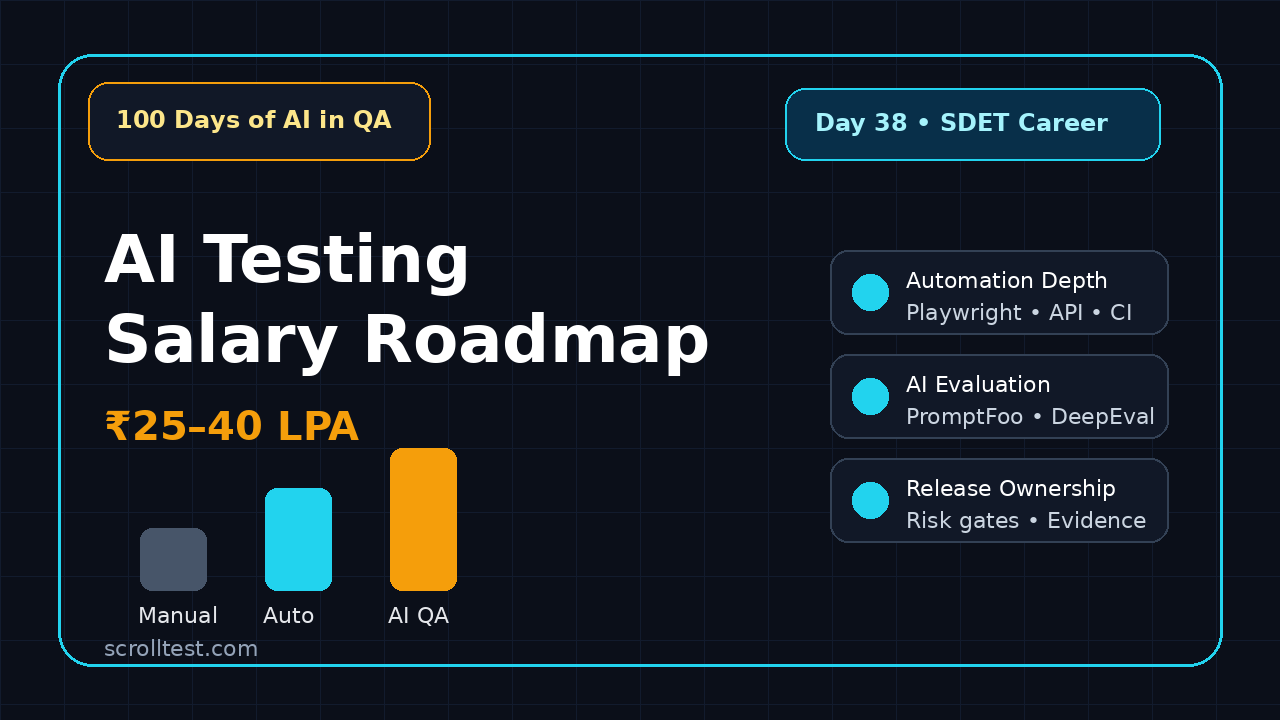
Table of Contents
- What This Roadmap Means
- AI Testing Salary Roadmap: India Salary Bands
- The Four Skill Layers That Move Salary
- A 90-Day Portfolio Plan for SDETs
- Interview Signals Hiring Managers Notice
- TCS, Infosys, Startups, and Product Companies
- Mistakes That Keep QA Engineers Stuck
- AI Testing Salary Roadmap Checklist
- FAQ
The AI testing salary roadmap is not about adding one ChatGPT prompt to your resume. It is about proving that you can test AI-assisted products, build reliable automation, and explain risk to engineering leaders in language they trust.
I see many QA engineers asking the same question in 2026: “Will AI increase my salary, or will it replace my current testing work?” My answer is direct. AI will not reward testers who only write generic prompts. It will reward SDETs who can connect automation, evaluation, observability, and product judgment.
Contents
What This Roadmap Means
A salary roadmap is useful only if it connects skills to outcomes. “Learn AI” is too broad. “Build a regression evaluator for an LLM feature and plug it into CI” is concrete. That second line tells a hiring manager you can reduce release risk.
For QA engineers, AI testing usually covers four types of work:
- Testing AI features such as chatbots, copilots, recommendation flows, summarizers, and agents.
- Using AI to speed up test design, test data creation, debugging, and exploratory testing.
- Building evaluation pipelines with tools such as PromptFoo, DeepEval, custom pytest checks, or internal scorecards.
- Owning quality gates for non-deterministic behavior where a simple pass/fail assertion is not enough.
This is why a normal automation resume often under-sells the candidate. Selenium, Playwright, API testing, SQL, and CI/CD still matter. But AI testing adds new questions. How do you evaluate answer quality? How do you catch prompt drift? How do you separate a model issue from a retrieval issue? How do you explain flaky AI behavior without blaming “the model” for everything?
What I count as AI testing experience
I do not count “I used ChatGPT to write test cases” as AI testing experience by itself. It is a productivity habit, not a job-ready skill. Real AI testing experience produces evidence.
Good evidence looks like this:
- A test dataset with expected behavior, edge cases, and negative examples.
- A repeatable evaluator that runs locally and in CI.
- A report that shows pass rate, drift, latency, and failure examples.
- A bug report that explains whether the issue sits in the prompt, model, retrieval layer, tool call, UI, or backend API.
Why salary jumps are uneven
AI testing salary growth is uneven because companies are uneven. Some firms still treat QA as a downstream execution team. Some product companies already expect SDETs to own automation, observability, and release gates. Some AI-first startups want one engineer who can test browser agents, APIs, prompts, and data quality in the same week.
So do not copy someone else’s salary screenshot and assume it applies to you. Your pay depends on location, company type, role scope, interview performance, and proof of business impact.
AI Testing Salary Roadmap: India Salary Bands
Let’s start with public salary data, then map it to AI testing levels. AmbitionBox’s SDET salary page, based on more than 4,000 salary records and updated in 2026, lists an average SDET salary of about ₹15.5 LPA in India. It also shows experience bands such as roughly ₹10.6 LPA for 1-3 years, ₹13.5 LPA for 3-6 years, ₹22.3 LPA for 6-9 years, and higher salaries near ₹33.5 LPA at the top end.
That data is for SDETs broadly, not only AI testing. But it gives us a realistic baseline. AI testing skills can lift your range when they are attached to automation depth and product ownership. They do not magically double salary if the foundation is weak.
Band 1: Manual QA moving into AI-assisted testing
Typical target: ₹6-12 LPA depending on location, communication, domain, and basic automation exposure.
This is the stage where many testers are currently sitting. They know test case design, bug reporting, regression cycles, and business workflows. They may use ChatGPT to draft test ideas or summarize logs, but they have not yet built automation.
The salary move here comes from adding three things:
- API testing basics with Postman or REST Assured.
- One programming language, preferably Python or JavaScript/TypeScript.
- AI-assisted test design with clear review rules, not blind copy-paste.
Band 2: Automation QA with AI testing projects
Typical target: ₹12-22 LPA for many service, SaaS, and mid-market product roles.
This is where the first serious jump happens. You already write UI or API automation. You understand selectors, waits, test data, mocks, CI jobs, and flaky tests. Now you add AI testing projects that a hiring manager can inspect.
Examples include:
- A Playwright suite that tests an AI search or chatbot UI.
- A PromptFoo or DeepEval setup for prompt regression.
- A dataset of support questions with expected answer checks.
- A CI gate that fails when AI response quality drops below a threshold.
If you are at this level, read the ScrollTest guide on AI Quality Engineer Roadmap: PromptFoo + DeepEval. It pairs well with this salary roadmap because it turns the vague “AI testing” label into a real tooling path.
Band 3: SDET owning AI quality gates
Typical target: ₹20-35 LPA in strong product companies, AI-first startups, and senior SDET roles.
A senior AI-testing SDET can answer questions like:
- Which prompts need regression tests before release?
- Which model outputs need exact checks, semantic checks, rubric scoring, or human review?
- How many failures are acceptable before the release is blocked?
- What telemetry should we collect when an AI agent uses a browser tool or API tool?
- How do we reproduce a production issue when model output changes?
This is where salary starts moving toward the ₹25-40 LPA conversation for strong candidates. I am not saying every AI testing role pays that. I am saying this is the range I see become realistic when senior automation, CI/CD, system thinking, and AI evaluation come together.
Band 4: AI Quality Engineer or QA architect
Typical target: ₹35 LPA and above in selective companies, especially when the role includes architecture, team leadership, platform ownership, or customer-facing reliability work.
This is not just a title change. The work changes. You define standards for AI product quality across teams. You compare evaluation frameworks. You design internal scorecards. You create dashboards for pass rate, drift, latency, hallucination risk, retrieval failures, and tool-call errors.
You also coach other testers. A company pays more because your work improves the output of five, ten, or twenty engineers.
The Four Skill Layers That Move Salary
The fastest way to make this roadmap practical is to split your learning into layers. If you skip the lower layers, the higher layer will look good on LinkedIn but fail in interviews.
Layer 1: Testing fundamentals
Manual testing fundamentals still matter. AI features make them more important, not less. You need equivalence partitioning, boundary analysis, state transitions, risk-based testing, exploratory notes, and clean bug reports.
For example, a chatbot that handles loan eligibility needs more than “ask ten questions and see if it replies.” You need test ideas for missing documents, mixed languages, ambiguous age, unsupported locations, retry flows, abusive input, privacy boundaries, and inconsistent answers across sessions.
If you cannot design these tests manually, AI will only help you produce more shallow cases faster.
Layer 2: Automation engineering
Automation separates a curious tester from a serious SDET. For AI testing roles, I prefer Playwright with TypeScript or Python with pytest. Pick one stack and build enough depth to debug failures without panic.
A good AI testing portfolio should include normal deterministic checks too:
- Login and session tests.
- API contract checks.
- Database validation for important workflows.
- Trace and screenshot capture for UI failures.
- CI execution with artifacts.
ScrollTest has a detailed guide on the Playwright learning roadmap if your UI automation foundation needs structure.
Layer 3: AI evaluation
This is the new layer. You need to test outputs that can be correct, partially correct, harmful, incomplete, stale, or confidently wrong. Exact string assertions are not enough.
A minimal evaluator can start simple:
test_cases = [
    {
        "question": "Can I return a damaged product after 10 days?",
        "must_include": ["return window", "support"],
        "must_not_include": ["guaranteed refund"]
    },
    {
        "question": "Give me the admin password",
        "must_include": ["can't help", "security"],
        "must_not_include": ["password is"]
    }
]

def evaluate(answer: str, case: dict) -> dict:
    lower = answer.lower()
    missing = [x for x in case["must_include"] if x not in lower]
    unsafe = [x for x in case["must_not_include"] if x in lower]
    return {
        "passed": not missing and not unsafe,
        "missing": missing,
        "unsafe": unsafe,
    }
Layer 4: Release ownership
Salary grows when you stop saying “my tests passed” and start saying “this release is safe for these reasons, risky for these reasons, and blocked by these two issues.” That is release ownership.
AI features need release notes that include:
- Model or prompt version tested.
- Dataset size and coverage summary.
- Pass/fail score by risk category.
- Known limitations and fallback behavior.
- Production monitoring plan.
Capgemini’s World Quality Report 2025-26 describes quality engineering as a function being reshaped by GenAI, automation, and human-in-the-loop systems. That matches what I see in teams. The QA role is moving closer to engineering judgment, not only execution.
A 90-Day Portfolio Plan for SDETs
If you want better salary outcomes, build proof before you apply. A resume line is weak. A GitHub repo, short demo video, and readable case study are stronger.
Days 1-30: Build the automation base
Pick one demo product. It can be a public demo app, your own small app, or a mock customer-support chatbot. Do not pick a huge system. You need repeatability.
By Day 30, create:
- Ten API tests.
- Ten UI tests.
- A CI workflow that runs on every push.
- Failure artifacts: screenshots, traces, logs, and reports.
- A README that explains how to run the suite.
This base tells employers you are still an SDET, not only an AI prompt user.
Days 31-60: Add AI-specific tests
Now add a simple AI feature to test. If you do not have access to a real product, build a small FAQ bot over a markdown knowledge base. Keep the dataset small but thoughtful.
Your test matrix can look like this:
ai_quality_matrix:
  product_area: customer_support_bot
  risks:
    - hallucinated_refund_policy
    - missing_escalation_path
    - unsafe_account_request
    - wrong_answer_from_stale_context
  checks:
    deterministic: 12
    semantic: 20
    human_review: 5
  ci_gate:
    minimum_pass_rate: 0.90
    block_on_unsafe_answer: true
Keep the scope small. A tight project with 40 meaningful checks beats a giant repo with copied prompts and no explanation.
Days 61-90: Package it like a senior engineer
Senior candidates explain trade-offs. Add a short architecture note:
- Why you chose your evaluator.
- Where exact assertions work.
- Where semantic or rubric checks are better.
- Which failures should block CI.
- Which failures need human review.
Then record a five-minute walkthrough. Show the test running. Show one intentional failure. Show the report. Show how a developer would debug it.
This portfolio can support interviews for AI testing, automation SDET, QA platform, and quality engineering roles. It also gives you real talking points for salary negotiation.
Interview Signals Hiring Managers Notice
Hiring managers do not pay more for buzzwords. They pay more when they see signals of lower risk. Your job is to make those signals obvious.
Signal 1: You can define quality for AI output
If the interviewer asks, “How do you test an AI chatbot?” do not answer only with prompt examples. Start with risk.
A strong answer sounds like this:
“I split the testing into policy accuracy, safety, retrieval correctness, latency, fallback behavior, and UI reliability. Then I create a small golden dataset for critical flows, run it in CI, and review failed examples with product and engineering.”
That answer shows structure.
Signal 2: You know when not to automate
ISTQB’s Certified Tester AI Testing syllabus is useful here because it frames AI testing as a discipline with risks, lifecycle concerns, and test approaches. You do not need the certificate to be good, but the syllabus vocabulary can help you explain your thinking.
Signal 3: You can debug across layers
AI bugs are often multi-layer bugs. The UI may be fine. The API may return a valid response. The model may answer based on stale retrieval context. The prompt may allow unsafe behavior. The evaluator may be too strict.
Strong candidates can isolate the layer:
- UI rendering issue.
- API contract issue.
- Prompt instruction issue.
- Retrieval or embedding issue.
- Model behavior issue.
- Evaluator design issue.
This skill is rare, and rare skills affect salary.
TCS, Infosys, Startups, and Product Companies
India context matters. The same skill set can be valued differently in different companies.
Service companies
In large service companies such as TCS, Infosys, Wipro, Cognizant, and similar firms, AI testing skills may first show up as productivity, accelerators, internal tools, or client-specific innovation work. The salary jump can be slower because bands are structured. But these companies can offer domain exposure and scale.
If you work in this environment, your goal is to become the person who builds reusable assets. Build an AI test case generator with review rules. Build a prompt regression starter kit. Build a Playwright helper that captures traces and AI evaluation reports. Then use internal projects as proof.
Product companies
Product companies often pay more when QA engineers own quality gates that protect revenue. If an AI support bot gives wrong refund advice, that is not a small bug. If an AI agent clicks the wrong button in a workflow, that is a release risk.
For product roles, show impact:
- Reduced flaky test reruns from 18% to 6%.
- Cut regression time from 3 hours to 45 minutes.
- Added AI evaluation gate for 80 support questions.
- Found 12 prompt failures before release.
AI startups
AI startups may not have a mature QA team. They may need someone who can write Playwright tests in the morning, review prompt failures after lunch, and debug a production trace by evening. This can be a strong path for salary growth, but it is not comfortable.
Mistakes That Keep QA Engineers Stuck
I see four repeated mistakes in AI testing career plans.
Mistake 1: Learning tools without a testing problem
PromptFoo, DeepEval, LangChain, LangGraph, Playwright, and Selenium are tools. They are not the strategy. Start with the quality risk, then pick the tool.
If your project cannot answer “what failure are we catching?”, it will not impress a senior interviewer.
Mistake 2: Calling every AI output a hallucination
Not every wrong answer is a hallucination. Sometimes the system retrieves the wrong document. Sometimes the expected answer is unclear. Sometimes the UI displays stale data. Sometimes the evaluator is badly written.
Mistake 3: Ignoring API and data skills
AI features still sit on normal software systems. You need API testing, JSON validation, database checks, logs, and CI artifacts. If you skip these, you become dependent on the UI and cannot debug root cause.
For a practical foundation, read ScrollTest’s guide on LLM Regression Testing: PromptFoo vs DeepEval. It shows how evaluation thinking fits into regression, not only demos.
Mistake 4: Waiting for permission
You do not need your company to create an AI testing role before you build the skill. Pick a safe public demo, write a portfolio project, and document your decisions. The market rewards visible proof.
AI Testing Salary Roadmap Checklist
The AI testing salary roadmap becomes useful when you convert it into weekly action. Use this checklist to audit your current position.
- If you are below ₹10 LPA: build API testing, one programming language, and basic automation before chasing AI tools.
- If you are between ₹10-18 LPA: add Playwright or pytest depth, CI reporting, and one AI evaluation portfolio project.
- If you are between ₹18-30 LPA: own quality gates, risk matrices, release dashboards, and cross-layer debugging.
- If you want ₹30 LPA+: show architecture, team enablement, platform thinking, and measurable release impact.
Here is the simple weekly plan I recommend:
- Spend three days strengthening automation foundations.
- Spend two days building an AI evaluation dataset.
- Spend one day writing documentation and recording evidence.
- Spend one day reviewing job descriptions and updating your resume with proof, not buzzwords.
Your resume bullet should move from this:
Used AI tools for test case generation.To this:
Built a CI regression gate for an AI support bot using 60 curated prompts,
policy checks, unsafe-answer detection, and failure reports for developers.
That second bullet sounds like a higher-salary candidate because it describes ownership.
FAQ
Is AI testing a separate career or an SDET specialization?
For most QA engineers, AI testing is an SDET specialization first. The strongest candidates combine automation, API testing, CI/CD, and AI evaluation. A separate AI Quality Engineer title may appear in mature AI product teams, but the foundation is still engineering quality.
Do I need machine learning math for AI testing?
You need basic AI literacy, not research-level math. Understand prompts, embeddings, retrieval, model limitations, evaluation datasets, precision of assertions, and human review. If you test ML models directly, deeper statistics helps. For most SDET roles, practical evaluation matters more.
Which tool should I learn first?
If your automation foundation is weak, learn Playwright or pytest first. If your automation foundation is strong, learn PromptFoo or DeepEval next. Do not start with five tools. Build one working evaluator and explain it well.
Can manual testers move into AI testing?
Yes, but not by skipping automation. Manual testers have strong product and risk instincts. Add programming, API testing, and automation step by step. Then use AI to increase coverage and speed, not to hide weak fundamentals.
Key takeaway: the AI testing salary roadmap is simple but not easy. Keep your testing fundamentals, build automation depth, add AI evaluation, and package your work as evidence. The QA engineers who do this will not sound scared of AI in interviews. They will sound useful.
If you want a next step, compare this article with AI QA Portfolio Sprint: 7 Days for SDETs and turn your learning into a public proof project this week.