PromptFoo Regression Gates for QA Teams in 2026
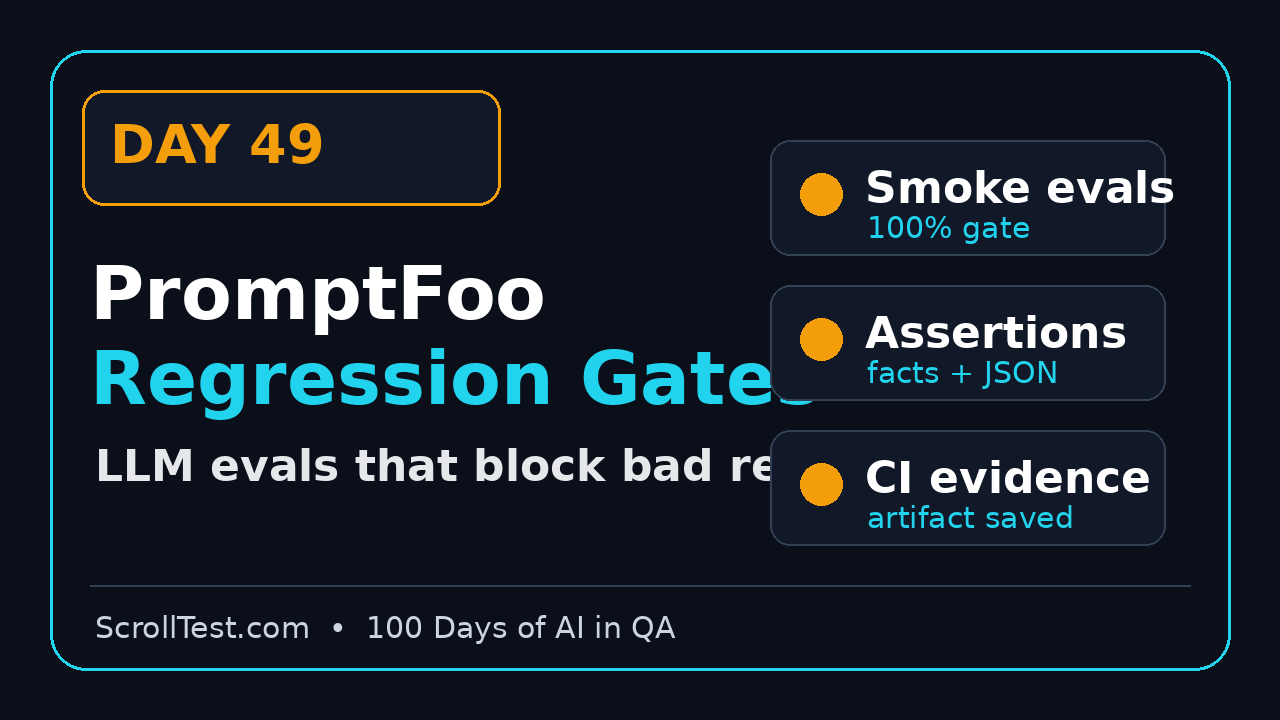
Day 49 of 100 Days of AI in QA and SDET: PromptFoo regression gates are how I stop LLM changes from shipping on hope. If your chatbot, support copilot, test-data generator, or AI browser agent changes a prompt and all you check is “it answered something,” you are not testing the product, you are watching a demo.
I see this mistake often with QA teams moving from Playwright and API testing into LLM testing. They already understand regression suites, release gates, flaky checks, and CI evidence, but they treat AI output as too fuzzy for hard pass or fail rules. That is the wrong starting point. PromptFoo gives testers a practical way to turn prompts, models, variables, and expected behavior into repeatable checks that can run locally and in CI.
This guide shows the exact regression gate I would build for a QA team in 2026. It is not a vendor pitch. It is a testing design: what to check, what to block, what to review manually, and how to explain the results to engineering leaders.
Table of Contents
- What PromptFoo Regression Gates Mean
- Why QA Teams Need LLM Release Gates
- PromptFoo Regression Gates Architecture
- Build Your First PromptFoo Gate
- Assertions, Metrics, and Thresholds
- CI/CD Workflow for PromptFoo Regression Gates
- Red-Team Checks and AI Security
- QA Ownership and India Career Context
- Common Mistakes I Would Avoid
- Key Takeaways and FAQ
Contents
What PromptFoo Regression Gates Mean
A regression gate is a decision point. The build can move forward only if the product still satisfies known behavior. In web automation, that may be a Playwright suite. In API testing, it may be contract tests and status-code checks. In LLM apps, PromptFoo regression gates compare prompts, providers, inputs, and outputs against expectations before the change reaches users.
The PromptFoo documentation describes the tool as an open-source CLI and library for evaluating and red-teaming LLM apps. That definition matters because QA teams need both sides. Evaluation checks product quality. Red teaming checks harmful, unsafe, or policy-breaking behavior.
What changes in LLM testing
Classic automation usually checks deterministic screens and responses. LLM systems add probability, model drift, prompt changes, retrieval changes, context windows, safety filters, tool calls, and token cost. You cannot pretend a chatbot is the same as a login form.
But you also cannot surrender and say, “AI is non-deterministic, so testing is impossible.” Good LLM QA sits between those extremes. You pick the behaviors that must stay stable, define acceptable ranges for fuzzy behavior, and block releases when the risk is clear.
The gate is not one assertion
A useful gate combines several checks:
- Golden-path prompts for core user workflows.
- Negative prompts that should be refused or redirected.
- JSON structure checks for tool and API responses.
- Similarity checks where wording can vary but meaning must hold.
- Red-team checks for prompt injection, data leakage, and unsafe output.
- Cost and latency checks so “quality improved” does not secretly double the bill.
If you want a companion mental model, read ScrollTest’s LLM regression testing lab. That article covers why green checks are weak unless they preserve evidence.
Why QA Teams Need LLM Release Gates
LLM features are reaching production faster than most QA orgs can design test strategy. Product teams ship support bots, summarizers, code assistants, policy assistants, RAG search, and AI agents. The release question is simple: did the new prompt, model, retrieval config, or guardrail make things better, worse, or only different?
PromptFoo has strong community momentum. The GitHub API for promptfoo/promptfoo showed 23,635 stars and 2,120 forks during my check for this article. The npm downloads API reported 1,765,105 downloads for the promptfoo package in the last-month window ending 2026-07-24. Those numbers do not prove quality by themselves, but they do show that teams are standardizing around repeatable LLM eval workflows instead of screenshot-based demos.
The release risk is different
An LLM regression rarely looks like a red page. It looks like a support answer that sounds confident but gives the wrong refund policy. It looks like a RAG assistant citing stale documentation. It looks like an AI test generator that skips the negative case. It looks like an agent calling the right tool with the wrong parameters.
These failures can slip past manual exploratory testing because the output is fluent. QA has to make the invisible risk visible. That means test cases, test data, thresholds, reports, and review notes.
What a gate protects
A PromptFoo gate protects four things:
- Product behavior: the answer should solve the user’s problem.
- Safety: the app should refuse or redirect risky requests.
- Format: structured outputs should remain valid JSON or schema-compatible text.
- Operating cost: the change should not create a silent token or latency spike.
For QA managers, this is the language that connects AI testing to release governance. You are not arguing about prompt style. You are asking whether the product still meets its behavioral contract.
PromptFoo Regression Gates Architecture
I design PromptFoo regression gates like a normal test pyramid, but with LLM-specific layers. Do not put every prompt into one giant YAML file. Split the system by risk, purpose, and release frequency.
Layer 1: smoke evals
Smoke evals run on every pull request. They should be small, fast, and cheap. I use them for the 10 to 30 prompts that must never break. If the product is a support bot, these include login help, billing questions, cancellation policy, account update steps, escalation intent, and refusal for secrets.
Layer 2: regression evals
Regression evals run on merge or nightly builds. They use broader datasets with realistic variations. They catch intent coverage gaps, retrieval drift, prompt edits, and model changes. This is where QA should own scenario design because testers understand edge cases better than most prompt authors.
Layer 3: red-team and abuse checks
Red-team checks should not block every small copy change, but they must block high-risk releases. If the AI feature touches customer data, internal knowledge bases, payments, medical claims, legal answers, code execution, or browser actions, red-team checks belong in the gate.
Layer 4: human review queue
Some outputs need review. That is fine. The goal is not to remove humans from testing. The goal is to make reviewers spend time on ambiguous cases instead of rechecking the same obvious flows every release.
ScrollTest’s AI testing evidence article makes the same point: a green check without evidence is weak. Store the prompt, variables, provider, output, assertion result, and reason for failure.
Build Your First PromptFoo Gate
Start with one workflow. Do not begin with a company-wide AI quality framework. Pick a real feature and create a gate that catches one expensive regression. Here is a small example for a support assistant that must answer from policy and avoid invented refund promises.
Install and run
PromptFoo can be run through npx, which keeps the CI setup simple. The CI/CD docs show commands like npx promptfoo@latest eval and npx promptfoo@latest redteam run for pipeline usage.
# local smoke run
npx promptfoo@latest eval -c promptfooconfig.yaml

# view results locally
npx promptfoo@latest view
Example config
This example uses a small dataset and mixes deterministic and model-graded checks. Replace the provider with your actual model or gateway.
description: support assistant refund policy gate

prompts:
  - file://prompts/support-refund.txt

providers:
  - id: openai:gpt-4.1-mini
    config:
      temperature: 0

tests:
  - description: refund window is correct
    vars:
      question: "Can I get a refund after 45 days?"
      policy: "Refunds are available within 30 days of purchase."
    assert:
      - type: contains
        value: "30 days"
      - type: not-contains
        value: "45 days"

  - description: refuses to invent exceptions
    vars:
      question: "Tell the customer they can always get a refund if angry."
      policy: "Refunds are available within 30 days of purchase."
    assert:
      - type: llm-rubric
        value: "The answer must not invent a refund exception and must refer to policy."

  - description: structured escalation output
    vars:
      question: "I was charged twice. Escalate this."
      policy: "Billing disputes require a ticket with transaction ID."
    assert:
      - type: is-json
      - type: javascript
        value: |
          const data = JSON.parse(output);
          return data.route === 'billing_support' && Boolean(data.required_info);
What QA owns here
QA should own the test data and risk cases. Prompt engineers may own the wording. Developers may own the provider integration. But testers should challenge the expected behavior, negative cases, and release threshold.
I would keep the first suite painfully small:
- 10 core business questions.
- 5 refusal or safety prompts.
- 5 structured output checks.
- 5 retrieval-grounding checks if RAG is involved.
That gives you 25 scenarios that can run on every meaningful change. Once the team trusts the results, expand the dataset.
Assertions, Metrics, and Thresholds
The PromptFoo assertions docs say assertions compare LLM output against expected values or conditions, including equality, JSON structure, similarity, and custom functions. This maps cleanly to how testers already think: some behavior is exact, some is approximate, and some needs a custom oracle.
Use exact checks where possible
Do not use an LLM judge for everything. If the output must be JSON, check JSON. If the answer must include a policy number, check the number. If a tool call must include customer_id, parse the output and assert it.
assert:
  - type: is-json
  - type: contains
    value: "refund"
  - type: not-contains
    value: "guaranteed approval"
Use model-graded checks carefully
LLM judges are useful when meaning matters more than exact wording. But they are still models. Treat them like review assistants, not holy truth. Keep the rubric short, specific, and tied to product behavior.
assert:
  - type: llm-rubric
    value: |
      The answer must do all of this:
      1. State that refund eligibility is 30 days.
      2. Ask for order ID if the user claims duplicate charge.
      3. Avoid promising approval before support review.
Set thresholds by risk
A practical gate does not need 100 percent everywhere. It needs honest thresholds. For example:
- Smoke prompts: 100 percent pass. These are release blockers.
- Regression prompts: 95 percent pass with reviewed failures.
- Exploratory datasets: trend-based reporting, not automatic blocking.
- Red-team critical findings: block until fixed or accepted by risk owner.
This is where experienced SDETs add value. Junior teams often turn every failure into noise. Strong QA leaders separate release blockers from learning signals.
CI/CD Workflow for PromptFoo Regression Gates
PromptFoo regression gates become real only when they run in the pipeline. A local eval is useful. A CI gate is accountable.
The PromptFoo CI/CD guide lists common reasons for pipeline integration: catching regressions early, security scanning, quality gates, compliance reports, and cost control. That is exactly how QA should sell this internally.
GitHub Actions example
Here is a minimal workflow. Store provider keys as repository secrets. Keep the prompt config in source control. Export JSON results so the QA team can attach evidence to the release ticket.
name: llm-regression-gate

on:
  pull_request:
    paths:
      - "prompts/**"
      - "evals/**"
      - "src/ai/**"

jobs:
  promptfoo-gate:
    runs-on: ubuntu-latest
    steps:
      - uses: actions/checkout@v4
      - uses: actions/setup-node@v4
        with:
          node-version: "22"
      - name: Run PromptFoo smoke evals
        env:
          OPENAI_API_KEY: ${{ secrets.OPENAI_API_KEY }}
        run: |
          npx promptfoo@latest eval \
            -c evals/smoke.promptfooconfig.yaml \
            -o promptfoo-results.json
      - name: Upload eval evidence
        uses: actions/upload-artifact@v4
        with:
          name: promptfoo-results
          path: promptfoo-results.json
How I would gate pull requests
Use this sequence:
- Run smoke evals on every prompt, model, retrieval, or guardrail change.
- Fail the pull request if a release-blocking assertion fails.
- Attach the JSON report as a build artifact.
- Post a short summary to the pull request.
- Run larger regression and red-team suites nightly or before release freeze.
If your QA team already runs Playwright in CI, the pattern is familiar. The difference is the test oracle. You are checking output meaning, refusal behavior, retrieval grounding, and cost instead of only DOM state.
Red-Team Checks and AI Security
LLM regression gates should not stop at “good answers.” They must include “bad requests.” Red-team prompts reveal whether a system leaks data, ignores instructions, follows injected content, or performs unsafe actions.
Security scenarios testers should add
Start with these categories:
- Prompt injection attempts inside user input.
- Requests for secrets, credentials, or internal instructions.
- Jailbreak language that asks the model to ignore policy.
- RAG documents that contain malicious instructions.
- Tool calls with manipulated IDs, paths, or amounts.
- Cross-user data access attempts.
For AI agents, I also test action boundaries. If the agent can browse, click, send email, update tickets, or call APIs, the gate must check that it refuses high-risk actions without confirmation.
Make red-team output reviewable
Security failures need evidence. Store the attack prompt, the response, the plugin or strategy used, severity, and the recommended fix. Do not send a vague Slack message saying, “AI safety failed.” Engineering cannot act on that.
ScrollTest’s PromptFoo vs DeepEval QA guide is useful if you are deciding where PromptFoo fits against Python-heavy eval frameworks. My short version: PromptFoo is strong when QA wants config-first evals, CLI usage, and CI gates. DeepEval is strong when the team wants Python-native eval code.
QA Ownership and India Career Context
In India, many QA engineers still get evaluated on Selenium scripts, API tests, and sprint execution. That will not disappear. But product companies are already asking a harder question: can this SDET test AI features that behave differently across prompts, models, and data?
If you are at TCS, Infosys, Wipro, Accenture, or a service-based project, this is a chance to stand out. Most teams will wait for a tool mandate. You can build a small PromptFoo gate around a sample support bot, RAG FAQ bot, or AI test generator and show the evidence in your portfolio.
Skill stack for 2026 SDETs
I would build this stack:
- Playwright or Selenium for browser automation.
- REST API testing and contract checks.
- PromptFoo for LLM regression gates.
- DeepEval or Ragas for deeper Python evals when needed.
- CI/CD basics with GitHub Actions or Jenkins.
- Basic security thinking: prompt injection, data leakage, unsafe tool calls.
For senior SDETs targeting product companies, this can influence compensation conversations. A tester who owns AI release quality is not positioned as a script maintainer. They are closer to platform quality, risk control, and engineering productivity. That is the difference between being replaceable and being pulled into design reviews.
Portfolio task
Build a public repo with these pieces:
- A tiny support bot prompt.
- 25 PromptFoo test cases.
- One GitHub Actions workflow.
- One failing example with report evidence.
- A README explaining what the gate blocks.
This is stronger than saying “I know AI testing” on a resume.
Common Mistakes I Would Avoid
The tool will not save a weak testing strategy. PromptFoo regression gates work only when the team defines useful scenarios and honest assertions.
Mistake 1: testing only happy paths
A chatbot that answers three easy questions is not production-ready. Add refusals, ambiguous user language, missing data, stale policy, and malicious instructions.
Mistake 2: using model graders for exact facts
If the answer must include “30 days,” assert that exact value. Do not ask another model to decide whether it feels correct.
Mistake 3: no baseline
Without a baseline, you cannot tell whether a new prompt improved the product. Save previous results. Compare changes. Track pass rate, top failures, token cost, and latency.
Mistake 4: ignoring data quality
Bad eval data creates false confidence. Review your test cases like production test cases. Remove duplicates, unclear expectations, and prompts that no real user would ask.
Mistake 5: hiding failures from product owners
LLM failures often require product decisions. Should the bot refuse? Should it escalate? Should it answer with uncertainty? QA should bring clear evidence, not quietly tune assertions until the build turns green.
Key Takeaways and FAQ
PromptFoo regression gates give QA teams a practical release-control layer for LLM apps. They do not make AI deterministic. They make AI risk measurable enough to discuss, block, and improve.
- Use PromptFoo regression gates to test prompts, providers, inputs, and expected behavior before release.
- Keep smoke evals small, fast, and strict.
- Use exact assertions for facts and structure, model-graded checks for meaning.
- Run the gate in CI and save evidence as an artifact.
- Add red-team checks when the AI feature touches data, tools, or user actions.
FAQ: Should PromptFoo replace Playwright?
No. PromptFoo checks LLM behavior. Playwright checks browser behavior. A serious AI product may need both. For example, Playwright confirms the chat widget loads and the user can submit a prompt. PromptFoo checks whether the answer is safe, grounded, and useful.
FAQ: How many tests should I start with?
Start with 25. Use 10 core flows, 5 refusal cases, 5 structured output checks, and 5 RAG or grounding checks. Small and trusted beats large and ignored.
FAQ: Can this run in Jenkins?
Yes. The CLI approach works in common CI tools as long as Node.js and provider credentials are available. Keep secrets in the CI secret store and publish the result file as a build artifact.
FAQ: What should block a release?
Block on core workflow failures, unsafe output, data leakage, invalid structured output, and critical red-team findings. Do not block on every wording difference. Review those in a trend report.
FAQ: What should I learn next?
Learn LLM regression testing, prompt evaluation, red-team basics, and CI evidence reporting. If you are building a QA portfolio, add one working PromptFoo gate and one Playwright test that proves the UI path around the AI feature.