Self-Healing Test Automation: How AI Fixes Broken Tests
Your test suite is failing for reasons that have nothing to do with your app. A button moved, a class was renamed, and now 40 tests are red while the product works fine. Self-healing test automation promises to fix that automatically, and in this guide I will show you what it actually does, where it lies to you, and how to use it without losing control of your suite.
Table of Contents
- What Self-Healing Test Automation Actually Means
- A Short History: Why “Self-Healing” Keeps Getting Rebranded
- The Data: Why Flaky Tests Are So Expensive
- Self-Healing Test Automation in the Wild: Two Tool Families
- Where Self-Healing Test Automation Works (and Where It Lies)
- How AI Actually Fixes a Broken Test
- The FlakyGuard Lesson: Context Is Everything
- Building Self-Healing In Without Losing Control
- Prevention Beats Healing: The Playwright Approach
- India Context: Why SDETs Need This Skill in 2026
- Key Takeaways
- FAQ
Contents
What Self-Healing Test Automation Actually Means
Every QA team has lived the same Monday morning. The developers shipped a “small UI refactor” on Friday, and now 40 tests fail, not because the app is broken, but because the button moved from #submit-btn to [data-testid="submit"]. The product works. The tests are lying. Self-healing test automation is the attempt to make that problem disappear by having the tool or an AI model detect the breakage and repair the test, usually without a human in the loop.
Let me be precise, because “self-healing” has become a marketing word that hides three very different things:
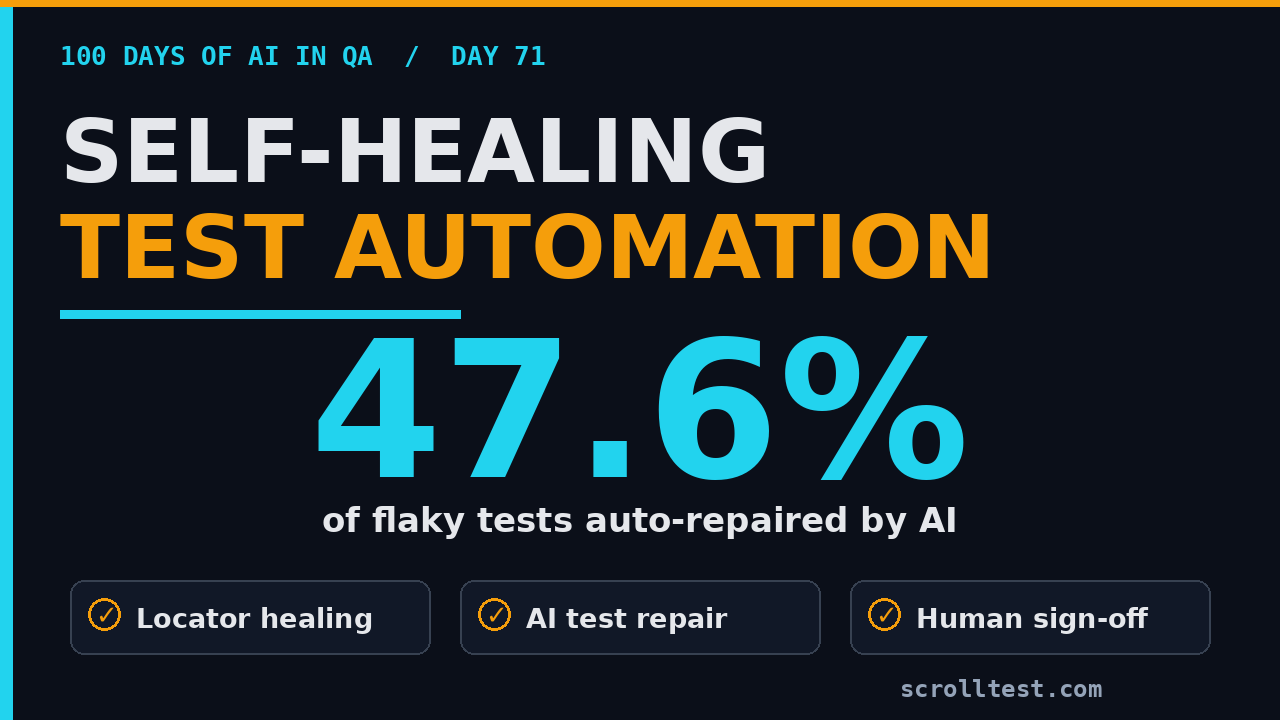
- Locator healing: the tool notices a selector is stale, scans the page for a close match, and swaps in the new one.
- Test repair: an AI model reads the failing test and the production code, then rewrites the assertion or the step that broke.
- Wait/retry self-adjustment: the framework quietly retries flaky steps or extends a timeout instead of failing.
Only the first two are real healing. The third is just hiding flakiness, and I will explain why that is dangerous later. The core idea across all three is the same: shift the maintenance burden of your test suite from humans to software. A 2024 study that analyzed 452 commits across large JavaScript projects found that concurrency-related flakiness, mostly async waits and race conditions, is the single biggest source of unreliable tests. That is exactly the class of failure self-healing tools promise to absorb.
A Short History: Why “Self-Healing” Keeps Getting Rebranded
Self-healing is not new. It has been rebranded three times in the last two decades, and knowing the lineage keeps you from overpaying for old wine.
Wave 1: Record-and-playback with fuzzy matching. Early commercial tools recorded clicks and stored brittle coordinates. When the page moved a pixel, everything broke. Vendors patched this with “smart” object recognition that matched elements by nearby text and image snapshots. It worked about as well as you would expect, which is to say it produced a lot of false positives.
Wave 2: The Page Object Model and stable locators. Selenium-era engineers solved the brittleness problem the honest way: abstract the locators into page objects so a change lands in one file, not four hundred tests. This was never marketed as self-healing, but it removed most of the maintenance pain that healing tools now sell against.
Wave 3: AI-assisted repair. This is where we are now. LLMs can read a failing test, the stack trace, and the production code, and produce a plausible fix. The research is genuinely new: systems like FlakyGuard and FlakyDoctor are the first to attempt repair at the level of test logic, not just selectors. The marketing, however, still leans on the old promise that you can stop maintaining tests altogether, and that promise has never been true.
The throughline: every wave promised to eliminate test maintenance, and every wave actually moved the maintenance around. The honest framing is that self-healing changes who reviews the fix and how fast, not whether maintenance exists.
The Data: Why Flaky Tests Are So Expensive
I do not like vague claims about “flaky tests cost billions,” so here are numbers I can stand behind.
- Playwright alone clocks 322 million npm downloads a month and 94,700+ GitHub stars. The dominant browser-testing stack is now JavaScript/TypeScript, which means the flaky-test problem lives mostly in the async-heavy JavaScript world.
- The JavaScript flaky-test study (452 commits analyzed) named async waits, race conditions, and deadlocks as the leading causes of flakiness, ahead of UI-timing and third-party-service issues.
- FlakyGuard, a 2025 LLM-based test-repair system built for industrial codebases, repaired 47.6% of reproducible flaky tests, and developers accepted 51.8% of its fixes. Its creators report it outperforms prior state-of-the-art approaches by at least 22% in repair success rate.
What those numbers tell me is not “the robots will fix everything.” They tell me the problem is real, it is measurable, and the gap between what AI can fix today and what teams waste time fixing by hand is wide enough to care about. A single flaky test can send a developer down a 30-minute rabbit hole every other sprint, and at 15+ tests per suite, that is real engineer-hours leaking out of every release cycle.
Self-Healing Test Automation in the Wild: Two Tool Families
When a vendor says “self-healing,” figure out which family they belong to, because they do not behave the same way.
Family 1: Selector and Locator Healing
These tools intercept element-lookup failures and try to find a new locator. Healenium is the best-known open-source option in this space, built as a self-healing library for Selenium WebDriver tests. Commercial platforms such as Testim, mabl, Katalon, and AccelQ also advertise self-healing selectors as a headline feature. The mechanics are similar across all of them: when a locator stops resolving, the tool scores candidate elements by attributes, position, text, and accessibility role, then rewrites the locator to the best match.
The appeal is obvious for large Selenium estates. Selenium still sits at 34,000+ GitHub stars, and a lot of those suites run brittle XPath and CSS selectors written years ago. Healing them automatically sounds like free money.
Family 2: AI Test Repair
This is the newer, more ambitious category. Instead of just swapping a locator, an LLM reads the failing test, the stack trace, and the surrounding production code, then produces a corrected test. FlakyGuard and its predecessor FlakyDoctor are research systems in this family, and the direction of travel is clear: treat test repair as a code-repair task, not a selector-patching task.
The difference matters. Locator healing fixes where the test looks. AI test repair fixes what the test asserts and how it reasons. The first is a bandage; the second, done right, is closer to a maintainer.
When I help a team choose, the decision is rarely about features and almost always about risk appetite. A large legacy Selenium estate gets most of its value from Family 1, because the failures are overwhelmingly stale selectors, and the blast radius of a wrong locator swap is small and easy to spot in a diff. A modern TypeScript/Playwright codebase has fewer stale-selector failures and more logic-level failures, so Family 2 is where the upside is, but only with a human gate on assertion changes. Mixing the two without a clear boundary is how teams lose track of which tests they can still trust.
Where Self-Healing Test Automation Works (and Where It Lies)
I have watched teams buy self-healing tools, turn on auto-repair, and quietly ship a regression suite that passes for reasons nobody understands. Here is my honest scorecard.
Where it genuinely works:
- Selector drift from cosmetic changes: a button that moved, a class renamed, a wrapper div added. Healing saves real time here.
- High-volume smoke suites where the cost of a human triage pass dwarfs the occasional wrong fix.
- Legacy Selenium estates with thousands of brittle locators and no test-ID discipline.
Where it lies to you:
- Healing a wrong assertion is a bug, not a feature. If the app behavior changed and the tool “fixes” the test to match the new, broken behavior, your suite now green-lights a regression. A healed test that no longer checks the original contract is worse than a red test.
- Retry-based “healing” masks flakiness. If the fix is “run it again until it passes,” you have not healed anything. You have taught the pipeline to ignore a symptom.
- Auto-healing without an audit trail erodes trust. Six months later nobody knows which tests were machine-edited, so nobody trusts a green build anymore. That is how teams end up running two parallel suites.
The rule I give my team: healing is a fallback, never the first line of defense. Prevention and stable selectors come first, which I cover below.
How AI Actually Fixes a Broken Test
Let me show a concrete before-and-after so you can see where an LLM earns its keep and where it can silently betray you.
Start with a broken Playwright test:
// BEFORE: the developer renamed the button, so this selector is stale
test('user can submit the form', async ({ page }) => {
  await page.goto('https://app.example.com/checkout');
  await page.click('#submit-btn');   // FAILS: selector not found
  await expect(page.locator('.order-confirmed')).toBeVisible();
});
A locator-healing tool would scan the page, find the element whose role, text, and position most closely match the old #submit-btn, and rewrite the selector:
// AFTER healing: locator updated to a stable, accessible target
await page.getByRole('button', { name: 'Place order' }).click();
That is a clean heal. The assertion still checks what it always checked, and the step now points at a stable element. The risk shows up when the behavior changed and the model “heals” the wrong half of the test:
// DANGEROUS heal: the model changes the ASSERTION, not the locator
await expect(page.locator('.order-confirmed')).toBeVisible();
// becomes...
await expect(page.locator('.checkout-page')).toBeVisible();
That second version passes, but it no longer proves an order was placed. This is exactly why FlakyGuard’s 51.8% developer-acceptance rate matters more than its 47.6% repair rate: developers reject roughly half of machine fixes because the fix, while green, is wrong. Human sign-off on assertion intent is not optional, it is the product.
The FlakyGuard Lesson: Context Is Everything
FlakyGuard’s paper is worth your time because it names the actual bottleneck in AI test repair: the context problem. Give an LLM too little context and it cannot see why the test fails. Give it too much and it drowns in irrelevant code and makes a worse fix.
Their answer is to treat the codebase as a graph and walk only the relevant edges: the failing test, its imports, the functions it calls, and the state those functions touch. That selective exploration is what let them beat earlier systems by 22%+ in repair rate. The takeaway for QA teams is not “use FlakyGuard.” It is that AI repair quality is a function of context curation. If you are wiring an LLM into your own triage loop, the biggest lever is what you feed it, not which model you call.
This mirrors a point I make in my broader writeup on validating AI-generated tests: the model is rarely the bottleneck, the filtering and the context you give it are.
Building Self-Healing In Without Losing Control
If you want self-healing without handing the keys to a black box, here is the workflow I run with teams. It keeps humans in charge of intent and lets software handle the boring part.
- Stabilize selectors first. Add
data-testidattributes and prefer role-based locators. The best self-healing system is one that has almost nothing to heal. - Turn on locator healing as a fallback only, and log every heal. If a locator heals more than once in a month, it is a signal the selector strategy is broken, not a success story.
- Route assertion changes to a human. Let the tool heal locators automatically, but require a developer or senior QA to approve any change to an assertion or a step’s intent.
- Keep a repair ledger. Every machine edit goes into a review queue with a diff, so a green suite is never a mystery suite.
- Measure the right thing. Track “human triage minutes saved” and “false-positive fixes caught,” not “number of tests auto-healed.” The second metric will lie to you.
For teams already running an AI-assisted suite, this slots naturally into the kind of pipeline I walked through in the AI-augmented Playwright playbook.
Prevention Beats Healing: The Playwright Approach
Here is the uncomfortable truth: most of what people call self-healing is a cure for a disease you should not have caught. Playwright built its reputation on preventing the failures that healing tools exist to fix.
- Auto-waiting removes the hard-coded sleeps and race conditions that the JavaScript flaky-test study flagged as the top cause.
- Strict locators fail loudly when a selector matches multiple elements, forcing you to write precise, stable locators instead of silently picking the first match.
- Web-first assertions (
expect(locator).toBeVisible()) retry until the condition is met or a timeout expires, so you assert on state, not on timing.
Notice the pattern: Playwright does not “heal” a broken locator by guessing. It refuses to run on a sloppy locator in the first place. That is a philosophy difference. A framework that fails fast and forces good selectors will always beat a framework that silently rewrites your tests behind your back. Healing is a useful safety net, but prevention is the strategy.
India Context: Why SDETs Need This Skill in 2026
If you are an SDET in Bengaluru, Hyderabad, or Pune building a career, self-healing test automation is not a curiosity, it is a differentiator. Here is what I see on the hiring side.
Senior SDET roles in India now sit in the ₹25-40 LPA band, and the interview question has shifted. Managers are no longer asking “can you write a Playwright test.” They are asking “if your AI healing tool silently changed an assertion, how would you catch it before it shipped?” That is a judgment question, not a syntax question, and it is exactly where most candidates fold.
For a weekend portfolio project, build a small self-healing demo: take a Playwright suite, deliberately break three selectors and one assertion, wire a healing fallback (or a simple LLM triage script), and show the repair ledger plus the one assertion change you correctly routed to a human. That single artifact demonstrates more about how you think than a hundred generic test cases. It pairs well with the QA career roadmap I wrote for the manual-to-AI transition.
The broader shift is the same one I describe across this whole 100-day series: AI is not replacing the SDET who understands judgment. It is replacing the SDET who only executes. The engineer who knows why a healed assertion is dangerous, and builds the review gate to catch it, is the one hiring managers in Bengaluru and Pune are competing over. Learn the mechanics of self-healing, but lead with the skepticism. That combination is worth more than any single framework on your resume.
Key Takeaways
- Self-healing test automation comes in two real flavors: locator healing (swaps stale selectors) and AI test repair (rewrites broken steps and assertions). Retry-based “healing” is just flakiness with a nicer name.
- The problem it solves is real: async waits and race conditions are the top cause of flaky JavaScript tests, and a single flaky test burns real engineer-hours every sprint.
- AI repair works when context is curated. FlakyGuard repaired 47.6% of reproducible flaky tests by walking the code graph selectively, and developers accepted 51.8% of its fixes.
- The dangerous failure mode is a healed assertion. If the tool changes what a test asserts to match broken behavior, your green suite is silently approving regressions.
- Prevention beats healing. Stable test IDs, role-based locators, and Playwright’s auto-wait and strict mode eliminate most of what healing tools exist to fix.
- Keep humans on assertion intent, log every heal, and route machine edits through a review queue so a green build never becomes a mystery build.
FAQ
Is self-healing test automation just auto-retry?
No, and you should reject any vendor that equates the two. Auto-retry re-runs a flaky step until it passes, which masks the symptom. Real self-healing either repairs a stale locator or rewrites a broken test step and records the change. If there is no diff to review, there is no healing happening.
Does Playwright support self-healing tests natively?
Not in the “auto-rewrite my locator” sense. Playwright favors prevention: auto-waiting, strict locators, and web-first assertions that make flakiness rare in the first place. You can layer a healing tool or an LLM triage script on top, but the framework itself will not silently patch your selectors.
What is the biggest risk of enabling auto-healing?
Silent assertion changes. When a tool “fixes” a failing test by weakening or replacing its assertion to match the new behavior, the test passes while the regression ships. This is why assertion-level changes must always route to a human reviewer.
Can LLMs reliably repair flaky tests today?
Partially. The strongest published result (FlakyGuard) repairs 47.6% of reproducible flaky tests, with developers accepting 51.8% of the fixes. That means roughly half of repairs still need a human to correct or reject them, so treat LLM repair as a triage assistant, not an autopilot.
How do I start with self-healing on a real project?
Start with prevention: add data-testid attributes and role-based locators, then turn on locator healing as a logged fallback. Wire any assertion change into a human review queue, and measure triage time saved rather than the count of auto-healed tests. For a deeper walkthrough, see my AI-augmented Playwright playbook.