MCP Python SDK 2.0 Validation Plan for QA Teams
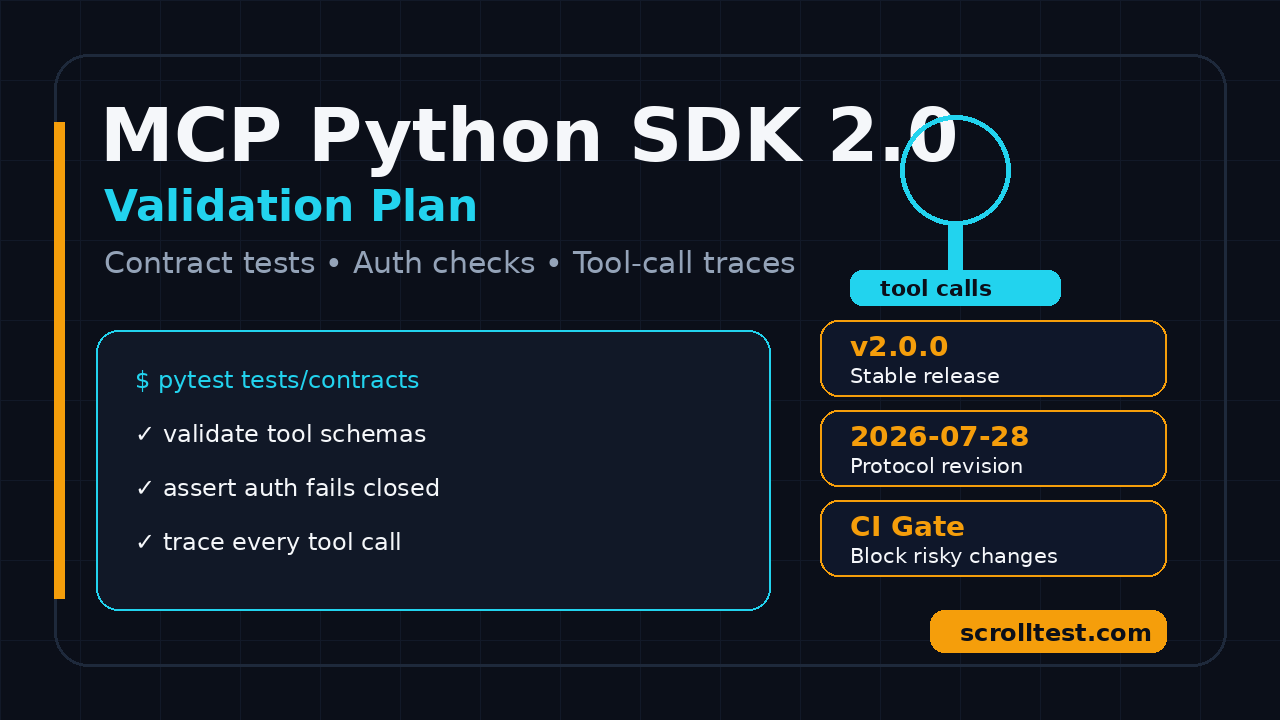
The MCP Python SDK 2.0 validation plan matters because MCP servers are moving from experiments into real QA-owned release pipelines. If your agent can call tools, fetch resources, and ask follow-up questions, you need more than a happy-path smoke test before you upgrade to v2.
Table of Contents
- Why This Release Matters for QA Teams
- MCP Python SDK 2.0 Validation Plan Overview
- Contract Tests for Tools, Resources, and Prompts
- Auth and Security Checks You Should Not Skip
- Tool-Call Observability and Evidence
- CI Upgrade Strategy for v1 to v2
- Sample QA Playbook and Code
- India QA Team Context
- Key Takeaways
- FAQ
Contents
Why This Release Matters for QA Teams
The official MCP Python SDK v2.0.0 release shipped on 28 July 2026 and marks the stable v2 line. The release notes say pip install mcp now installs 2.x, v1 is in maintenance mode, and v2 supports the 2026-07-28 revision while serving earlier protocol revisions from the same server.
That combination is useful, but it is also exactly where QA risk hides. A server that claims to support old and new clients can pass a quick manual check while breaking older agent integrations, auth boundaries, log expectations, or trace correlation.
The change is bigger than a package bump
In v1, many teams tested MCP by starting a server, listing tools, and calling one or two functions. That is not enough for v2. The release notes mention stateless requests, server/discover, subscriptions/listen, multi-round-trip requests, a first-class Client, OpenTelemetry tracing by default, hardened stdio behavior, and OAuth changes.
Each item creates a QA question:
- Does discovery return the same contract across client versions?
- Do rejected requests fail with a useful error and no leaked data?
- Does the server emit traces that connect an agent action to a tool result?
- Does a v1 client still work when the same service runs the v2 SDK?
- Does the server protect stdout when a tool prints debug noise?
The release data gives us a baseline
The GitHub repository for modelcontextprotocol/python-sdk shows more than 23,000 stars at the time of this run, with an MIT license and active issue traffic. That level of adoption means many internal QA teams will not be testing a niche library. They will be testing a protocol layer that product, support, data, and DevOps agents may depend on.
MCP Python SDK 2.0 Validation Plan Overview
A practical MCP Python SDK 2.0 validation plan has five layers. Do not start with end-to-end agent demos. Start with contracts. Then add auth, transports, observability, and release gates.
The five layers
- Contract tests: Validate tool schemas, resource names, prompt contracts, error envelopes, and backward compatibility.
- Transport tests: Run the same tool calls over stdio, Streamable HTTP, and any in-memory test transport your stack uses.
- Auth tests: Check valid tokens, expired tokens, missing scopes, client credentials, issuer validation, and identity assertions.
- Observability tests: Prove that every meaningful tool call creates traceable evidence, logs, timings, and correlation IDs.
- CI release gates: Block merges when the server contract changes without review, when a known v1 client breaks, or when auth regression appears.
This article focuses on the parts QA engineers can own without waiting for platform architecture meetings. If you want a smaller pre-release checklist first, read the ScrollTest MCP connector validation checklist and the MCP smoke test template. Use those as Day 0 checks, then expand into the plan below.
What changed in the SDK from a tester’s view
The MCP Python SDK v2 documentation highlights a simpler server and client model. FastMCP becomes MCPServer, and one Client replaces the older transport plus session plus initialize layering. That is cleaner for developers and better for QA because test setup can become shorter.
But shorter setup does not mean fewer assertions. It means you can write sharper tests around observable behavior instead of burning code on connection ceremony.
Definition of done for the upgrade
For a QA-owned validation plan, I use this definition of done:
- All public tools have schema snapshot tests.
- At least one old client and one new client pass the same core scenarios.
- Unauthorized calls fail closed with no partial tool execution.
- Every tool call has a trace ID, duration, input summary, output status, and error class.
- CI can run the validation suite in less than 10 minutes for pull requests.
- The team has a rollback pin such as
mcp>=1.28,<2documented for emergency use.
Contract Tests for Tools, Resources, and Prompts
Contract tests are the heart of MCP testing. Your agent may be clever, but it still depends on boring agreements: tool names, argument types, resource URIs, response shapes, and error codes.
Start with tool discovery
The MCP spec documentation for tools describes tools as executable functions exposed by a server for model use. For QA, the first check is not whether the tool can complete a business task. The first check is whether the server advertises the right contract.
Capture discovery output as a snapshot. Review it like an API contract. If a developer renames create_invoice to invoice_create, that might look harmless in code review. For an AI agent, it can break prompt templates, evaluator fixtures, routing logic, and production runbooks.
import json
import pathlib
import pytest

SNAPSHOT = pathlib.Path("tests/contracts/tools.snapshot.json")

@pytest.mark.asyncio
async def test_tool_contract_snapshot(mcp_client):
    tools = await mcp_client.list_tools()
    normalized = [
        {
            "name": tool.name,
            "description": tool.description,
            "input_schema": tool.input_schema,
        }
        for tool in sorted(tools, key=lambda t: t.name)
    ]

    current = json.dumps(normalized, indent=2, sort_keys=True)
    if not SNAPSHOT.exists():
        SNAPSHOT.write_text(current)
        pytest.fail("Tool snapshot created. Review and commit it.")

    assert current == SNAPSHOT.read_text()
This pattern is intentionally strict. If the contract changes, the test should fail. The team can then decide whether the change is safe, versioned, or accidental.
Validate argument boundaries
Schema snapshots are not enough. You also need boundary calls. For every high-risk tool, test missing required fields, wrong types, empty strings, long inputs, unknown enum values, and injection-shaped values.
For example, a run_sql_check tool should not accept a free-form query if the contract promises a safe query template. A create_ticket tool should not silently ignore a missing project key. A fetch_customer tool should not expose data when an ID is malformed.
BAD_CASES = [
    {},
    {"customer_id": ""},
    {"customer_id": "../admin"},
    {"customer_id": "A" * 5000},
    {"customer_id": 12345},
]

@pytest.mark.asyncio
@pytest.mark.parametrize("payload", BAD_CASES)
async def test_customer_lookup_rejects_bad_input(mcp_client, payload):
    result = await mcp_client.call_tool("lookup_customer", payload)

    assert result.is_error is True
    assert "validation" in result.error.message.lower()
    assert "email" not in json.dumps(result.model_dump()).lower()
Check resources and prompts separately
MCP servers often expose tools first, then resources and prompts later. QA teams sometimes miss this and treat list-tools as the whole API. Do not do that. Resource contracts and prompt templates can break agent behavior just as easily as tool schemas.
Create separate snapshots for:
- Resource URI patterns and MIME types.
- Prompt names, required arguments, and descriptions.
- Error structures for missing resources.
- Pagination or streaming behavior if the server supports large outputs.
If you already run LLM regression tests, connect this contract layer with evaluator tools. The ScrollTest guide on PromptFoo and DeepEval regression playbooks is a good next step after the MCP contract is stable.
Auth and Security Checks You Should Not Skip
The MCP Python SDK 2.0 validation plan needs explicit auth coverage because v2 includes hardened auth behavior. The release notes call out OAuth issuer validation, SEP-990 identity assertion flow, and client-credentials extension support.
Test fail-closed behavior first
Do not start with a valid token. Start with no token. Then use an expired token. Then use a token with the wrong audience, wrong issuer, wrong scope, and wrong client ID. Your goal is to prove the tool never runs when identity is not acceptable.
I like this matrix for pull requests:
- No credential: request rejected before tool execution.
- Expired credential: request rejected with an auth error, not a generic 500.
- Wrong issuer: request rejected under issuer validation.
- Missing scope: read-only token cannot call write tools.
- Wrong tenant: token for tenant A cannot access tenant B resources.
- Valid client credentials: machine-to-machine tools work only for allowed scopes.
Add one negative assertion to every auth test
Most teams assert the status code and stop. That misses partial execution bugs. Every auth test should include a negative assertion that the side effect did not happen.
@pytest.mark.asyncio
async def test_write_tool_needs_scope(mcp_client_factory, audit_log):
    client = mcp_client_factory(token="token_without_write_scope")

    result = await client.call_tool("create_refund", {
        "order_id": "ORD-1001",
        "amount": 100
    })

    assert result.is_error is True
    assert "scope" in result.error.message.lower()
    assert not audit_log.contains_event("refund_created", order_id="ORD-1001")
Use the official security guidance as a checklist
The Model Context Protocol site publishes security best practices. Convert the parts relevant to your server into tests. You do not need to automate every item on day one, but you should not leave security as a paragraph in a confluence page.
For internal QA teams, I recommend four security gates before production:
- All write tools require an explicit write scope.
- All sensitive read tools require tenant or project authorization.
- Tool output redacts secrets, tokens, email addresses, and private identifiers where required.
- Server logs and traces do not store raw credentials or full sensitive payloads.
Tool-Call Observability and Evidence
AI agent failures are painful because the failure is rarely one line. The model chose a tool. The server validated input. The tool called another service. A retry happened. Then the final answer looked confident but wrong. Without observability, QA is stuck reading screenshots and chat transcripts.
Turn traces into test evidence
The v2 release notes say OpenTelemetry tracing ships by default. Treat that as a testing feature, not only an SRE feature. Your test should assert that a tool call creates a trace with the expected attributes.
At minimum, capture:
- Tool name.
- Protocol version or negotiated client version.
- Trace ID and request ID.
- Input size or summarized input keys.
- Output status, not full sensitive output.
- Duration and retry count.
- Error class for failed calls.
@pytest.mark.asyncio
async def test_tool_call_emits_trace(mcp_client, trace_sink):
    result = await mcp_client.call_tool("calculate_tax", {
        "country": "IN",
        "amount": 1000
    })

    assert result.is_error is False
    spans = trace_sink.find_spans(tool_name="calculate_tax")
    assert len(spans) == 1
    assert spans[0].attributes["mcp.tool.name"] == "calculate_tax"
    assert spans[0].attributes["mcp.result.status"] == "success"
    assert spans[0].attributes["mcp.input.keys"] == ["country", "amount"]
Separate observability from logging noise
The release notes also mention hardened stdio and that stdout is diverted to stderr while serving. That matters. Agents that communicate over stdio can be fragile if a debug print contaminates the protocol stream.
Create one test where a tool prints noisy output. The protocol response should remain valid. The noise should land in a safe log channel, not in the message stream.
@pytest.mark.asyncio
async def test_stdio_noise_does_not_break_protocol(stdio_client):
    result = await stdio_client.call_tool("tool_that_prints_debug", {})
    assert result.is_error is False
    assert result.content[0].text == "ok"
Make evidence useful for defect reports
A good MCP bug report should include the contract version, tool name, input fixture, trace ID, auth context, expected result, actual result, and whether the issue reproduces on v1 and v2 clients. That structure cuts triage time.
Here is a compact defect template:
- Tool:
lookup_customer - Client: v2
Clientover Streamable HTTP - Protocol: 2026-07-28 negotiated
- Auth: valid read scope, tenant IN-BLR-QA
- Fixture:
customer_id=C-9001 - Trace ID: copied from test output
- Expected: masked email and active subscription flag
- Actual: unmasked email returned
CI Upgrade Strategy for v1 to v2
The release notes are clear that v1.x is now in maintenance mode and will receive security fixes. That does not mean every team should merge v2 in one Friday deploy. It means teams need a controlled upgrade path.
Run both client eras during migration
Because v2 can serve earlier protocol revisions from the same server, your CI should test at least one old client path and one new client path during the migration window. This catches accidental breakage in users who upgrade later.
A simple matrix works well:
- Server v1 branch: existing contract suite, no new features.
- Server v2 branch with old client: compatibility checks for critical tools.
- Server v2 branch with new client: full contract and observability suite.
- Server v2 branch with auth negatives: security regression gate.
Gate on contract diffs, not screenshots
Agent demos are persuasive, but CI needs deterministic signals. Use JSON snapshots, pytest assertions, trace assertions, and linkable logs. Keep demo videos for stakeholder updates, not merge gates.
name: mcp-validation
on: [pull_request]

jobs:
  contracts:
    runs-on: ubuntu-latest
    strategy:
      matrix:
        client: [legacy, v2]
    steps:
      - uses: actions/checkout@v4
      - uses: astral-sh/setup-uv@v3
      - run: uv sync --all-extras
      - run: uv run pytest tests/contracts tests/auth tests/observability
        env:
          MCP_CLIENT_MODE: ${{ matrix.client }}
Keep rollback boring
Do not wait for a production incident to decide how rollback works. The release notes give a clear pin for projects not ready to migrate: mcp>=1.28,<2. Put that in the release plan, not only in a chat thread.
Sample QA Playbook and Code
This is the playbook I would hand to an SDET who has one week to validate MCP Python SDK 2.0 for an internal AI agent platform.
Day 1: Baseline the current server
Freeze the current behavior before touching the dependency. Run current v1 contract tests, export discovery results, collect two or three real production-like tool call transcripts, and list the tools by risk.
- Low risk: read-only tools with public or non-sensitive data.
- Medium risk: tools that read internal data or rely on tenant context.
- High risk: write tools, payment/refund/admin tools, and tools that trigger workflows.
Day 2 and 3: Build the contract suite
Add snapshot tests for tool discovery, resource discovery, prompt discovery, and error envelopes. Keep snapshots human-readable. Review them in pull requests just like OpenAPI files.
def normalize_error(result):
    return {
        "is_error": result.is_error,
        "code": getattr(result.error, "code", None),
        "message_family": result.error.message.split(":")[0].lower(),
    }
Do not snapshot volatile details such as timestamps, request IDs, or full stack traces. Snapshot the stable contract.
Day 4: Add auth negatives
Pick the top five risky tools. For each one, add no-token, wrong-scope, wrong-tenant, and expired-token tests. If your auth test setup is messy, fix that first. MCP servers are easy to demo and easy to over-permission.
Day 5: Add observability checks
Wire your test environment to a trace sink. It can be a local in-memory collector, a test fixture, or a lightweight OpenTelemetry collector in Docker. The goal is not perfect dashboards. The goal is proof that a failed test produces enough evidence for triage.
Day 6: Run migration and compatibility checks
Upgrade the package, run the suite, fix contract diffs, and run both old and new client paths. Read the official v1 to v2 migration guide before you decide a failure is a product bug. Some failures may be intended breaking changes.
Day 7: Release gate and rollback drill
Run the final suite in CI, publish the contract diff summary, and do one rollback drill in a non-production environment. If rollback takes more than 15 minutes, document the missing step before production.
India QA Team Context
In India, I see two types of MCP adoption right now. Service companies experiment with internal support agents and productivity tools. Product companies push harder into agentic QA, internal platform assistants, and dev-tool automation. The testing problem is the same, but the operating model is different.
Service company reality
In a TCS, Infosys, Wipro, or Accenture-style environment, QA teams often do not own the platform code. They receive a service, a staging endpoint, and a checklist. For those teams, the best move is to own black-box MCP contracts:
- Discovery snapshots from staging.
- Auth negative tests using approved test identities.
- Tool-call evidence in defect reports.
- Regression packs that run before client rollout.
This is enough to change the conversation from “the agent failed” to “the create_ticket tool contract changed and broke two client prompts.” That is a stronger QA signal.
Product company reality
In product companies, SDETs can usually get closer to the code and CI pipeline. If you are aiming for senior SDET or staff QA roles in Bengaluru, Hyderabad, Pune, or remote product teams, this is the kind of ownership that matters.
Strong SDETs in product companies commonly target the ₹25-40 LPA band and above depending on experience, company stage, and ownership. AI-agent testing skills will not magically raise salary, but they give you better interview stories: contract design, CI gates, security negatives, and observability.
What hiring managers will ask
Expect practical questions:
- How do you test an AI agent tool without relying on model output?
- How do you prove a tool did not execute after auth failure?
- How do you version tool schemas?
- How do you debug a wrong answer across model, tool, and backend layers?
- How do you run this in CI without flaky LLM calls?
The answer is this validation plan: deterministic contracts first, auth negatives second, observability third, model evaluation last.
Key Takeaways
The MCP Python SDK 2.0 validation plan is simple in principle: stop testing only the demo and start testing the contract. The SDK v2 release gives teams a cleaner client and server model, but QA still has to prove compatibility, safety, and evidence.
- MCP Python SDK v2.0.0 is a stable v2 release, not a casual patch upgrade.
- Start with tool, resource, and prompt contract snapshots before E2E agent demos.
- Auth tests must prove both rejection and no side effect.
- OpenTelemetry traces should become part of QA evidence for tool-call failures.
- Run old and new client paths during migration, then document rollback.
If your team already has MCP smoke checks, upgrade them into release gates. If you are starting from zero, begin with the top five tools by business risk and write the first contract snapshot today.
FAQ
Is MCP Python SDK 2.0 backward compatible?
The v2 release notes say the same server can serve every earlier revision while v2 speaks the 2026-07-28 revision. QA should still run real compatibility tests because your own tools, auth middleware, and clients may have assumptions outside the SDK.
Should QA test MCP with real LLM calls?
Use real LLM calls sparingly. Contract, auth, transport, and observability tests should be deterministic. Add LLM evaluation only after the tool contract is stable, otherwise a model variation can hide a server regression.
What is the first test I should write?
Write a tool discovery snapshot test. It catches accidental renames, schema changes, and missing tools early. Then add one bad-input test for your riskiest write tool.
How do I test MCP auth without production credentials?
Create test identities with controlled scopes and tenants. You need tokens for valid read, valid write, expired, wrong issuer, wrong tenant, and missing scope. If your team cannot create those safely, that is a platform testing gap worth raising.
Where should this run in CI?
Run contract and auth checks on every pull request. Run heavier cross-client and trace checks before release or nightly. Keep the PR gate under 10 minutes so developers do not bypass it.